GEO Is Not SEO - It Needs a Distinct Approach


Over the past 18 months, we’ve been watching Australian buyer behaviour evolve as AI has moved from curiosity to an everyday discovery tool. It hasn’t replaced Google, but it’s started reshaping how search engines drive performance at various parts of the funnel.
Rocket’s SEO team has been observing and testing this shift since ChatGPT and Perplexity first launched in 2022, then Bing and Grok evolved in 2023 and AI overviews took off in 2024. One thing is certain - generative engine optimisation is not SEO and does not work the same way. So treating it like it is will lead to the wrong investments for Australian marketers.
Let’s unpack why.
1. Buyers have already shifted
AI usage in research is rising rapidly. There’s plenty of research backing this:
- ChatGPT prompt volume rose ~70% in the first half of 2025 alone, with shopping-related queries doubling in popularity
- Around 50% of consumers now use AI-powered tools (ChatGPT, Gemini, Perplexity and others) to guide choices and brand evaluations
- 60% of U.S. adults use AI to search for information, rising to 74% among people under 30
And this isn’t just general browsing behaviour. It’s embedded in buying journeys.
In APAC, 93% of B2B buyers report using AI to support their buying process, typically at the beginning and middle stages of the buying journey
Closer to home, the Australian data is equally telling:
- Nearly half of Australians (~49%) have used generative AI tools in the last year
- Almost 4 in 10 Australians have used AI assistants instead of traditional search for exploration and comparison
- Around 45 - 50% of Australians have recently used generative-style AI tools, with highest adoption among working-age adults
If AI usage in research is rising this fast, and it clearly is, then part of your audience is no longer discovering, evaluating and shortlisting brands purely through traditional search.

2. Discovery is shifting before the click
The second shift is structural. AI is changing what happens before someone ever lands on a business's website. AI-generated summaries and answer layers mean zero-click behaviour is exploding:
- 60%+ of searches end without a site visit in some datasets when AI summaries are present
- Some media studies have flagged up to 80% fewer clickthroughs when AI summaries appear
When answers are synthesised directly in-platform, ranking second or even first isn’t the same competitive advantage it once was.
Visibility is no longer just about earning a position in a ranked list. It’s more important to be included in a summarised answer when your audience is looking for your product or service.
That’s a very different game compared to traditional SEO.
3. AI systems work differently from search engines
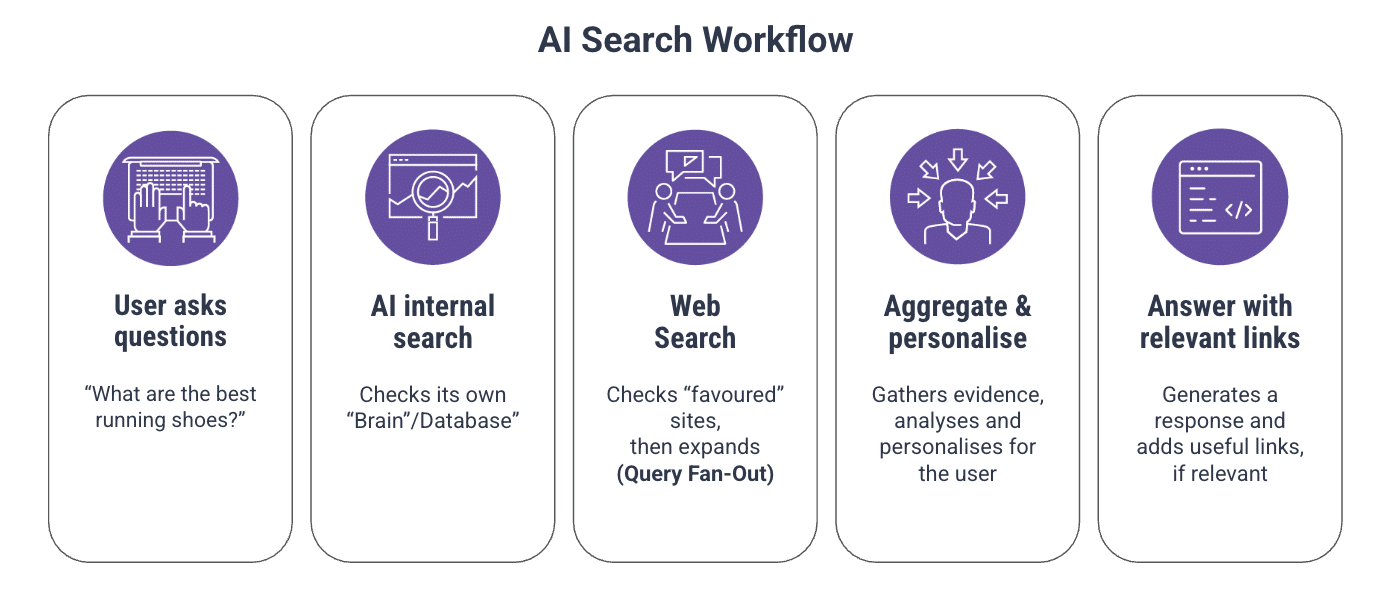
This is the critical distinction. The SEO industry has spun itself in knots over the past four years, with many saying that ranking in AI platforms like ChatGPT and Perplexity is the same as SEO. It’s just not true. Yes, there’s loads of overlap with the levers that one can pull to rank well in traditional search and the ones to pull to appear prominently in ChatGPT for a similar theme - but when to pull each lever is generally very different depending on the particular website/brand being optimised. Deploying a single strategy across both channels is typically a fast track to underperformance in one (if not both).
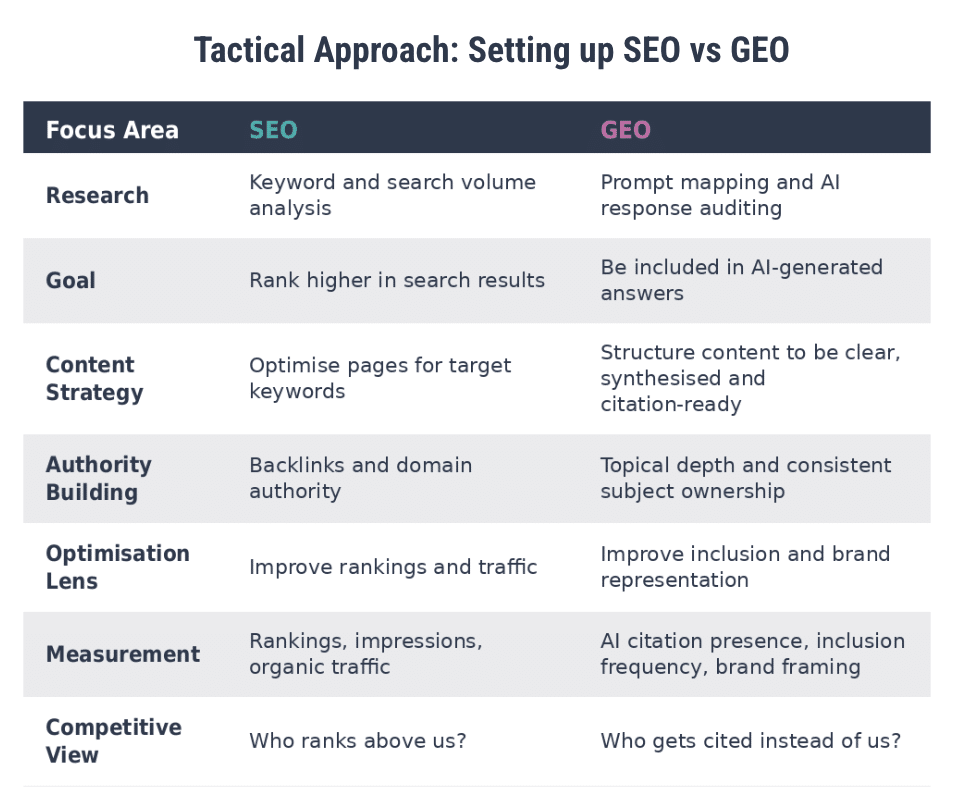
Search engines rank and list links, while AI systems synthesise and interpret responses.
Traditional SEO is built on signals like:
- Keywords
- Backlinks
- Crawlability
- Technical structure
- E-E-A-T (Experience, Expertise, Authoritativeness, Trustworthiness)
AI models, by contrast, surface content based on contextual modelling and relevance, not just keyword weightings. This is why we’re seeing research showing that:
- Standard SEO metrics explain only 4 - 7% of citation variance in ChatGPT (as shown in Josh Blyskal’s research)
- Being in Google’s top 10 gives you roughly a 25% chance of appearing in AI search (ZipTie data)
- An incredible point to support this argument is that 28.3% of ChatGPT-cited pages literally don’t appear in Google’s organic index
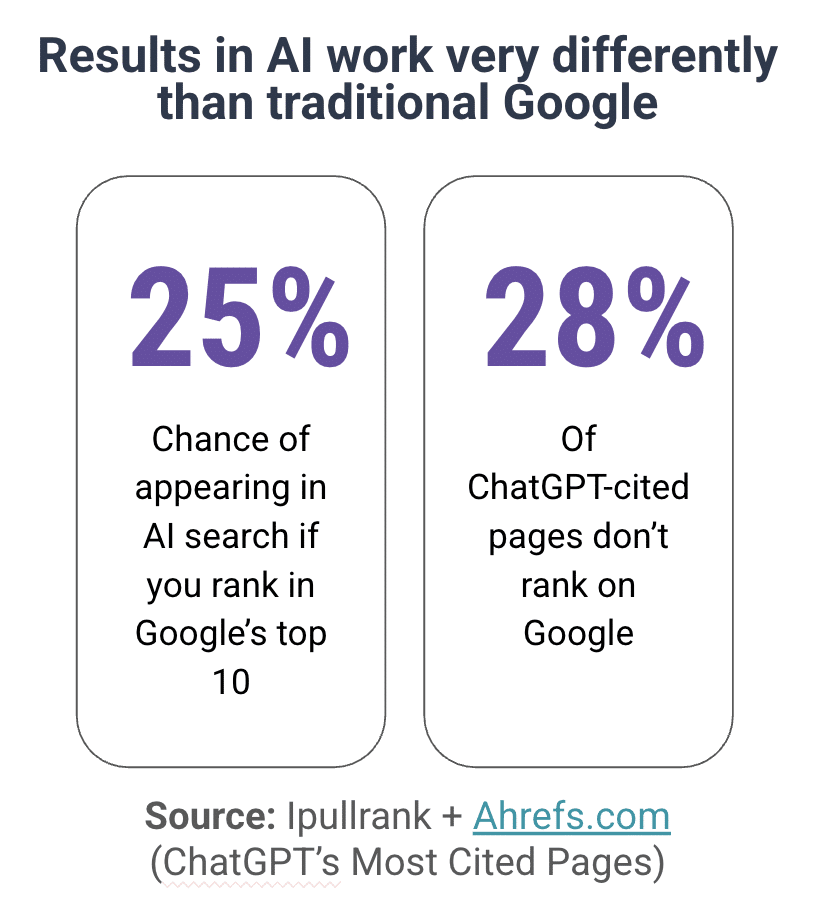
This means nearly a third of pages cited in ChatGPT responses have no meaningful organic ranking footprint. SEO performance does not reliably predict AI visibility, and AI visibility does not require traditional SEO dominance.
This is why calling GEO “SEO 2.0” misses the point.
4. Each AI channel behaves differently
Another nuance that matters for marketers is that not all AI environments operate the same way.
Citation distributions differ between Google AI Overviews and ChatGPT. What works in one environment doesn’t automatically transfer to another.
In fact, optimising for one AI surface may reduce performance on another, and changes intended to influence AI responses can, in some cases, affect traditional rankings.
Your strategy cannot be copy-paste.
AI optimisation requires:
- Content that is interpretable to models
- Contextual alignment with likely user prompts
- Structured authority signals
- Strategic positioning of narrative elements
The overlap with traditional SEO does exist, but the intent and execution differ.
So what should a GEO search strategy look like?
1. Map where AI influences your category
Before changing anything, understand:
- Are buyers using AI to compare vendors in your category?
- Are AI tools summarising “best providers” lists?
- Are they shaping pricing expectations?
- Are they defining evaluation criteria?
For many industries, AI is already influencing early and mid-funnel research, especially in B2B. That means your AI strategy should start at:
- Category education
- Problem framing
- Comparison content
- Authority positioning
2. Shift from ranking to being synthesised
Traditional SEO optimises for position. AI optimisation focuses on inclusion in summarised answers. That requires:
- Clear, structured explanations (no ambiguity for models to interpret)
- Strong topical depth (not surface-level keyword content)
- Consistent positioning language across your ecosystem
- Authoritative signals that extend beyond backlinks
The goal is, when someone asks an AI tool about this topic, does our perspective get woven into the answer?
3. Engineer authority, not just traffic
AI systems don’t simply reward page authority the way search engines historically have. They evaluate:
- Contextual relevance
- Semantic relationships
- Consistency across sources
- Citation patterns
That means authority must be built deliberately:
- Clear subject-matter ownership
- Original insights and data
- Strong alignment between your brand and specific topics
- External signals that reinforce credibility
4. Design for cross-channel balance
One of the most important nuances is that each AI surface behaves differently. What works for Google AI Overviews may not perform the same way in ChatGPT or Perplexity. And changes made purely for AI visibility can sometimes impact traditional search performance.
So your strategy needs to:
- Protect core SEO performance
- Enhance AI inclusion
- Avoid trade-offs that harm one channel to improve another
For in-house teams, that means AI optimisation cannot sit in isolation. It must be integrated with (but not absorbed into) SEO.
5. Monitor inclusion, not just rankings
Senior marketers are used to tracking rankings, impressions, CTR and conversions. AI visibility requires a different layer of monitoring:
- Are we being cited?
- Are we included in vendor comparisons?
- How is our brand being described?
- Are competitors appearing more often in AI-generated summaries?
It’s influence tracking, and in many categories, influence happens before the click.
6. Measurement is hard, but you need a framework
Measuring GEO effectiveness is also fundamentally different to SEO, and this is where many teams underestimate the shift. In traditional search, platforms like Google Search Console, Semrush and Google Analytics provide clear visibility into impressions, rankings, clicks and performance over time.
In AI environments, that layer doesn’t exist. Most platforms are closed ecosystems where users consume answers in-platform, click through less and attribution is fragmented or delayed. In many cases, AI influences the discovery stage and the buyer’s consideration, but the eventual conversion happens via a different channel, making the impact easy to miss if you’re relying on last-click or standard analytics models.
That doesn’t mean GEO can’t be measured, but it does require a different mindset and toolset. Instead of tracking rankings and traffic alone, marketers need to measure inclusion, visibility and influence. At Rocket, we combine a range of approaches to build this picture, including AI visibility tools and emerging GEO platforms to track brand mentions and competitive presence, alongside custom prompt tracking to monitor how clients appear across key queries. It’s not perfect, and there’s no single source of truth yet, but together these inputs provide a reliable view of whether your brand is being surfaced, how it’s being positioned, and whether that visibility is translating into commercial impact.
Final thoughts - SEO still matters, but it’s not sufficient
SEO remains foundational. Technical excellence, authority building and content strategy are still essential, but they don’t guarantee AI coverage.
If AI inclusion were purely a byproduct of SEO, we wouldn’t see minimal correlation between classic SEO metrics and AI citation.
Search used to be a ranked list, and now it’s ranked results, AI summaries, conversational responses and multi-step prompt flows.
The mechanics are different, so the strategy must be different. If your brand isn’t positioned for inclusion in these environments, you may be invisible in parts of the buyer journey you can’t easily measure.
In 2026, your business needs a strategy for organic search, and in Australia, given 95% of market share, this is typically synonymous with Google. However, the landscape has changed and you now need a strategy and measurement plan for GEO. AI engines aren't going anywhere and they are fast becoming the starting point for millions of buyer journeys in Australia each month.
If you’re evaluating where to invest next or whether your current search strategy fully covers the evolving discovery layer, we’re happy to explore it with you.
We’ve launched generative engine optimisation to help brands stay ahead of this shift, supported by our award-winning SEO team and years of hands-on industry adaptation. Reach out and we’ll be in touch.
About the Author

James is co-founder of multi-award-winning Australian digital marketing agency Rocket, keynote speaker, host of Apple’s #1 Marketing Podcast, Smarter Marketer, and co-author of the 2019 Amazon Australia’s #1 best-selling marketing book of the same name. He was also a finalist in 2019 and 2020 B&T Marketer of the Year.
James’ 15-year marketing career working with more than 500 in-house marketing teams inspired the 2019 release of Smarter Marketer. It has been endorsed by marketers at some of Australia’s leading brands, including Hubspot and KPMG.
In 2022, James launched the Smarter Marketer podcast, the definitive podcast for Australian marketers. Released fortnightly, James sits down with local experts and global authorities to discuss how Australian marketers can become more successful in their careers.