TikTok Search Is Surging in Australia. Here’s How Your Business Can Make the Most of It.


TikTok is rapidly becoming a serious discovery platform. Not because traditional search is disappearing, but because the way that millions of Australians prefer to explore, evaluate and validate is evolving.
This means search is no longer just about getting an answer but about building confidence.
Consumers increasingly want to:
- See the product in someone’s hand
- Assess a service provider visually before engaging
- Hear the trade-offs explained in plain language
- Watch someone use it, compare it, regret it, recommend it
- Scroll through multiple perspectives until the pattern becomes clear
This shift towards visual proof and social validation is accelerating as attention spans fragment and the volume of competing brand messages grows.
And the scale is huge.
TikTok now reaches 12.5 million+ Australians monthly, with 41% of Australian mobile users active on the platform each month. Users spend 90+ minutes per day on average, the highest daily screen time across major platforms, surpassing Facebook, Instagram and YouTube (Source: TikTok, 2025)
The average TikTok user in Australia is 33 years old. While younger audiences are driving behaviour change, the platform is far from youth-only:
- 25 - 34 year olds represent 46% of users
- 18 - 24 year olds account for 27%
- 35 - 44 year olds make up 13%
- 45+ users account for another 13%
Recent research from WARC adds another layer: 86% of 15 - 29 year olds use TikTok as a search engine weekly, and 84% of searches occur during the exploration phase when consumers are actively evaluating options.
That’s not passive scrolling. That’s high-intent discovery.
While younger Australians may be leading the behavioural shift, adoption across older demographics is firmly established and growing. Search habits formed on TikTok today will shape broader expectations around how products are researched tomorrow.
Even if TikTok is not yet central to your channel mix, your future customers are already forming search behaviours there. The brands that understand this early will be better positioned as those behaviours become mainstream.
How TikTok Search works
1. Indexing: How TikTok understands a video
Multiple signals are analysed by the algorithm to understand what a video is about:
- Spoken words (via speech-to-text transcription)
- On-screen text
- Captions and hashtags
- Comments and conversation themes
- Engagement patterns (who watches and what they also engage with)
This means what you say in a video matters just as much as what you write. If a creator clearly says, “Here’s how to choose the best mortgage broker,” that phrase becomes a searchable signal.
This is how TikTok turns video into structured, indexable content.
2. Matching: Connecting queries to content
When someone types a search query, TikTok looks for:
- Semantic alignment between the query and indexed video content
- Behavioural alignment (have people who searched similar terms engaged with this video?)
- Topical clusters (is this creator consistently posting about this subject?)
Unlike traditional search engines, TikTok’s matching system is deeply tied to user behaviour. If a certain style of answer consistently satisfies searchers, it will surface more often.
Autocomplete suggestions are also demand signals. What appears in the dropdown reflects common or rising search behaviour, which becomes an insight source for marketers.
3. Ranking: Why some videos surface first
Ranking on TikTok search is heavily influenced by:
- Watch time and completion rate
- Rewatches
- Shares and saves
- Comment depth (not just volume)
- Recency (for fast-moving topics)
- Creator authority within a niche
A video that perfectly matches a keyword but loses viewers in the first three seconds won’t rank well. Retention is the gatekeeper.
This is where TikTok differs structurally from other social platforms. It blends search intent with engagement validation. Content must both answer the query and hold attention.
Paid Search on TikTok
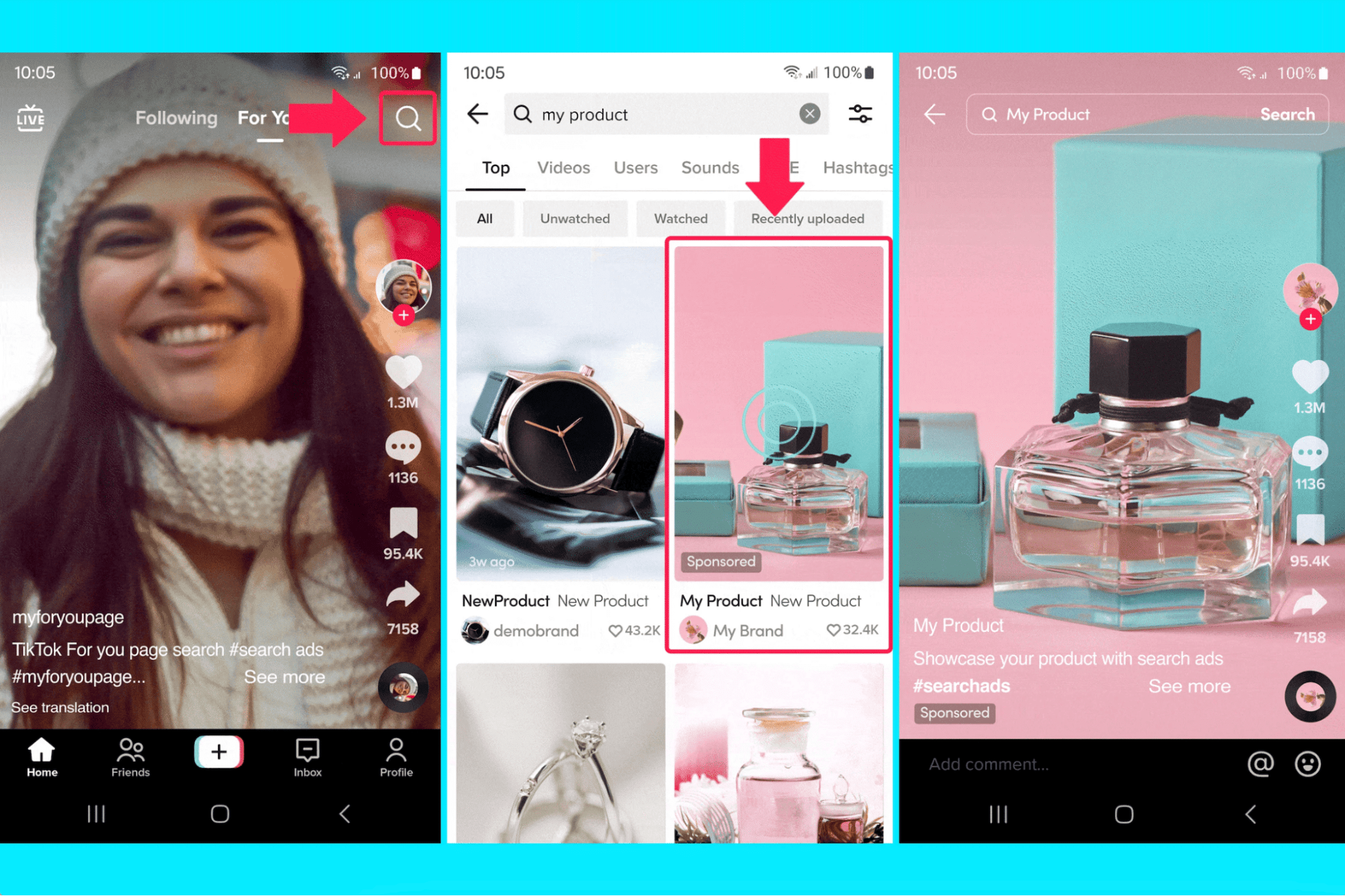
TikTok has also introduced search ads, meaning brands can appear within search results for high-intent queries. This creates a hybrid model: organic search visibility supported by paid amplification.
For marketers, that opens up a new performance layer. Search-driven creative can now be deliberately scaled.
Source: Agency Utopia
Why TikTok is structurally built for success in search
TikTok’s rise as a discovery layer isn’t accidental. It has invested in search as product infrastructure, not just as a feature.
1. Creator Search Insights
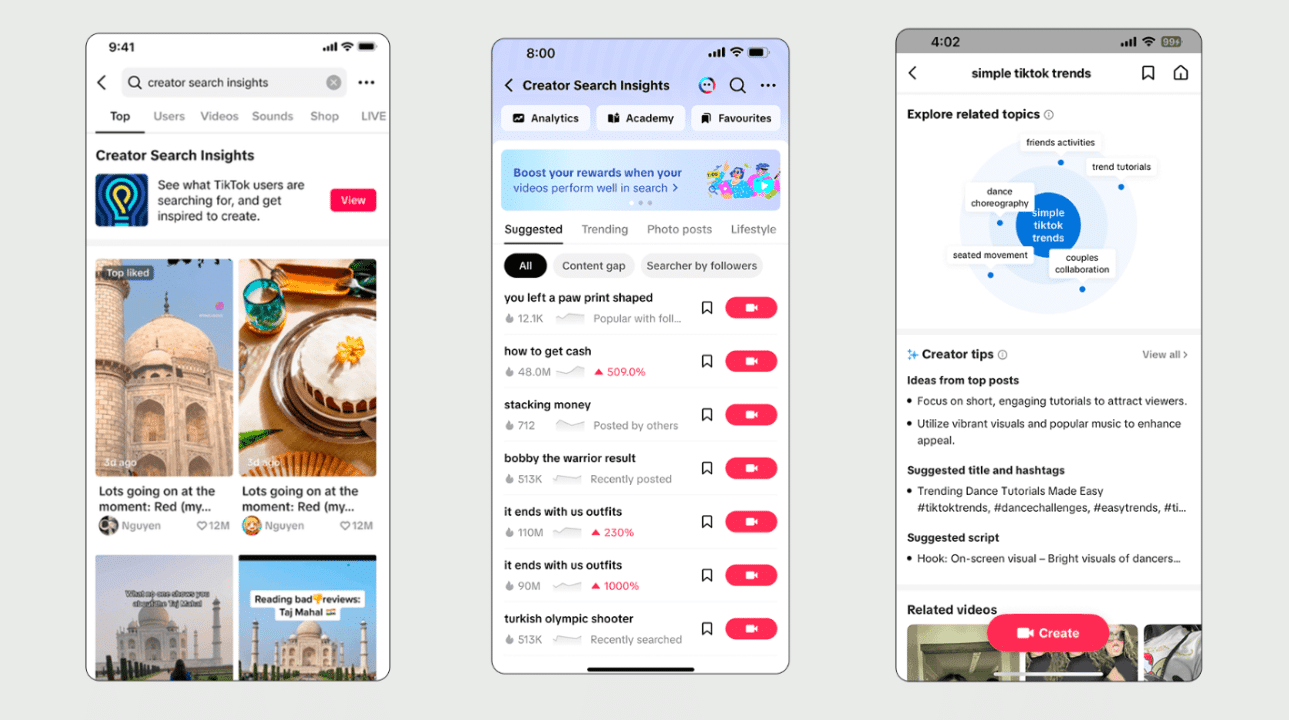
TikTok introduced Creator Search Insights, showing what users are actively searching for and highlighting content gaps, which are areas of high demand with low supply. This effectively turns search intent into a content opportunity map.
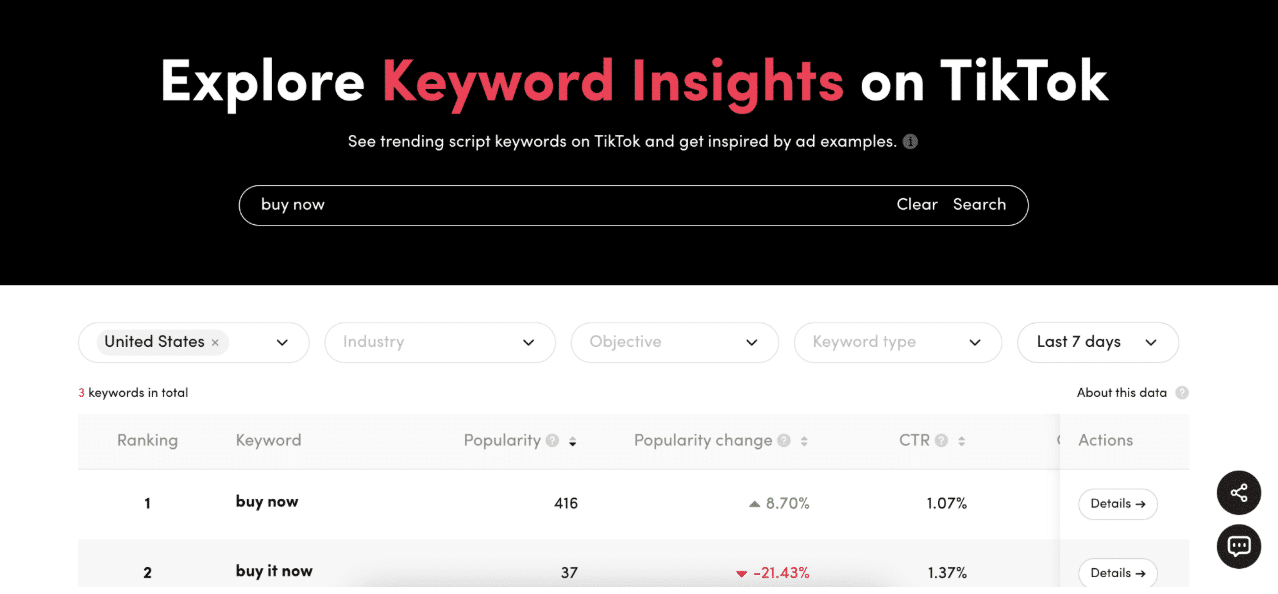
2. Keyword Insights in Ads Manager
TikTok Ads Manager includes Keyword Insights tools that surface high-performing phrases by region and industry. Creative and messaging can now be aligned to demand signals, not just demographic targeting.
3. Interest graph > Social graph
Unlike legacy social platforms that prioritise who you follow, TikTok prioritises what you engage with. That makes it structurally better at surfacing relevant answers to queries, even from creators you’ve never seen before.
Popular queries - Different ways people search on TikTok
Below are queries you (or your readers) can literally type into TikTok and see the behaviour in action.
1. “Is X worth it?” (Considered Purchase Intent)
Try searching:
- “Dyson Airwrap worth it”
- “UGG Tasman worth it”
- “Who Gives A Crap worth it”
What shows up:
- Side-by-side comparisons
- Honest reviews
- “Things I wish I knew before buying”
- 30-day follow-ups
Why this is search behaviour: This is mid-funnel intent, not browsing.
@georgiatoffolo Is the Dyson Airwrap actually worth the hype… or has Shark quietly stolen the show? I swear EVERYONE owns a Dyson but only 1 in 10 actually know how to use it… I’ve finally cracked the code. Save this before your next wash day: Top Tips 1️⃣ Never brush your hair when it’s wet - that’s when it’s at its weakest. 2️⃣ Step away from the hairspray - the Dyson’s heat / cooling air does the holding for you. 3️⃣ Always start with 80% dry hair - if it’s too wet, you’ll lose the curl before it’s even cooled. 4️⃣ Curl away from your face - trust me, face framing is key 5️⃣ Use the cool shot at the end - it sets the curls and adds shine. Products I swear by: @Dyson UK Airwrap @Living Proof, Inc. ♬ original sound - Georgia Toffolo
2. “How does X work?” (Explainer Intent)
Try searching:
- “How does Afterpay work”
- “How does HISA work Australia”
- “How does salary sacrifice work”
What shows up:
- Whiteboard explainers
- Finance creators breaking concepts down
- Accountants answering FAQs
Why this matters:
This is informational intent, which is traditionally SEO territory. But people prefer video explanation when the topic feels confusing.
You’ll often see:
- Creators outranking brands
- 60-second breakdowns outperforming blog posts
@beau_newton This is your sign not to check your Afterpay history! #afterpay @Afterpay AuNZ ♬ original sound - beau_newton
3. “X vs Y” (Comparison Intent)
Try searching:
- “ClickUp vs Asana”
- “iPhone 15 vs Samsung S24”
- “MECCA vs Sephora foundation”
What shows up:
- Split screen demos
- Honest pros/cons
- “Who this is actually for” framing
This is evaluation. For the same queries, Google returns structured comparison tables.
@barefacedmedia It’s easy to forget how powerful Sephora is when you’re only zoomed in on Australia. #sephora #sephoraaustralia #meccabeauty #aussiebeauty #beautytrends ♬ original sound - Barefaced
4. “Is X strict?” / “Is X legit?” (Trust & risk queries)
Try searching:
- “Jetstar strict with carry on”
- “Temu legit or scam”
- “Shein quality real life”
These are fear-based search queries.
TikTok shows:
- Airport gate footage
- Package unboxings
- Honest disappointment
This is where brands either gain trust or lose it. This is TikTok shaping perception before official messaging ever appears.
@miranabulsi Can someone please advice!! Like is Temu safe? Will i ever get my stuff? #temu #temufinds #temushopping #temuhaul #temumethod ♬ Got To Be Real (Αs performed by Cheryl Lynn) - Pop Music Workshop
5. “Best X for…” (Discovery Intent)
Try searching:
- “Best protein powder for women Australia”
- “Best mattress for back pain”
- “Best sunscreen for oily skin”
TikTok shows:
- Micro-niche creators
- Routine demos
- Long-term reviews
The difference is specificity. Google gives rankings and TikTok gives context.
@jbvcorrea as someone na super oily and pawisin, it’s a NO for me. Sorry 🫶🏻
♬ original sound - Wear Sunscreen 🌞
6. “Day in the life at X” (Employer Brand Search)
Try searching:
- “Day in the life accountant Australia”
- “Working at Canva”
- “Big 4 audit life”
This is talent discovery behaviour. Candidates use TikTok search to:
- Understand culture
- See office reality
- Assess lifestyle trade-offs
You’ll often find employee-generated content ranking above official recruitment content.
@paoloinaustralia What I actually do at Canva #canvalife #workingintech #career #tech #pinoyinaustralia #pinoysaaustralia🇵🇭🇦🇺 #pinoyaussie🇦🇺🇵🇭 #filipino ♬ A Day in My Life - Soft boy
7. “How to choose…” (Decision Framing)
Try searching:
- “How to choose a mortgage broker”
- “How to choose gym membership”
- “How to choose engagement ring shape”
TikTok shows:
- Step-by-step decision frameworks
- Red flags to watch for
- “What no one tells you” insights
This is where thought leadership can win. Brands that create educational, non-salesy explainers show up consistently.
@wallflowerr0 Off the market 💍❤️🩹 #fiancee #engaged #engagement #wifey #fyp ♬ Fiancé Anthem By ALTON KIING - ALTON KIING
How to get started with TikTok search
A strong TikTok strategy builds a deliberate discovery system that fits your funnel, stays on brand and aligns with how search visibility actually works.
- Step 1: Search Demand Mapping: Use Creator Search Insights and in-platform autocomplete to identify recurring intent themes and content gaps.
- Step 2: Competitor Visibility Audit: Document which formats win for each intent: POV, comparison, demo, myth-busting, objection handling.
- Step 3: Content Vertical Strategy: Build 4 - 6 repeatable verticals aligned to search behaviour:
- Explainers
- Proof
- Trade-offs
- Comparisons
- Objections
- Behind-the-scenes
- Step 4: Creative Engineering: Align spoken words, on-screen text, captions and metadata intentionally so videos are both watchable and retrievable.
- Step 5: Feedback Loop: Track retention, rewatches, search-driven views and comment themes. Feed insights into SEO, paid media, sales enablement and messaging strategy.
TikTok search sits at the intersection of content strategy, performance media and behavioural insight. For in-house marketers, the opportunity is to treat this as a discovery surface, build for real questions and earn trust in motion.
Your future audience is already searching TikTok and forming opinions before they reach your site. If you’re ready to make this space work harder for your brand, connect with our TikTok specialists - we’d love to help.
About the Author

James is co-founder of multi-award-winning Australian digital marketing agency Rocket, keynote speaker, host of Apple’s #1 Marketing Podcast, Smarter Marketer, and co-author of the 2019 Amazon Australia’s #1 best-selling marketing book of the same name. He was also a finalist in 2019 and 2020 B&T Marketer of the Year.
James’ 15-year marketing career working with more than 500 in-house marketing teams inspired the 2019 release of Smarter Marketer. It has been endorsed by marketers at some of Australia’s leading brands, including Hubspot and KPMG.
In 2022, James launched the Smarter Marketer podcast, the definitive podcast for Australian marketers. Released fortnightly, James sits down with local experts and global authorities to discuss how Australian marketers can become more successful in their careers.
Stay Ahead in Digital Marketing
Join 20K+ Marketers Who Get the Inside Scoop
Other Articles you might be interested in…