AI Search In Australia: Google, ChatGPT & The New Rules Of Visibility

Episode Description:
Is Google losing ground? How much traffic are tools like ChatGPT really driving? And what does visibility look like when answers increasingly happen inside AI platforms instead of on your website? In this episode, Host James Lawrence sits down with Rocket’s Head of SEO & GEO, Joe Alder, to unpack what’s actually happening inside AI search in Australia right now.
Drawing on Rocket’s latest GEO research across more than 150 Australian businesses and more than one million data points, they explore how platforms like ChatGPT, Google AI Overviews, Gemini and Perplexity are reshaping visibility, influence and digital measurement for brands, and what marketers should focus on next.
Watch our webinar: AI Search in Australia - How to Rank in ChatGPT & Google AI in 2026
Key Takeaways:
- Why Google search traffic is declining even while total search activity continues to grow
- How AI Overviews are impacting click-through rates for brands ranking in top Google positions
- What Rocket’s research revealed about the overlap between Google rankings and ChatGPT visibility
- Why ChatGPT influences purchasing decisions far beyond the traffic it directly sends to websites
- The growing importance of brand perception inside large language models
- Why AI search optimisation requires a different approach to traditional SEO
- The technical website issues preventing many brands from appearing in AI search results
- What types of content are performing best inside large language models
- Why authority, citations and off-site brand signals matter more than ever in AI search
- The metrics marketers should actually be tracking to measure AI search performance
Meet James Lawrence
Host, Smarter Marketer Podcast
Co-Founder of multi-award-winning Australian digital marketing agency Rocket, keynote speaker, host of Apple #1 Marketing Podcast, Smarter Marketer, and B&T Marketer of the Year Finalist.
James’ 15-year marketing career working with more than 500 in-house marketing teams and two decades of experience building one of Australia's top independent agencies inspired the release of Smarter Marketer in 2022, the definitive podcast for Australian marketers. The show brings together leading marketers, business leaders and thinkers to share the strategies that actually move the needle.
Each episode offers candid conversations, hard-won lessons and practical insights you can apply straight away.


James has delivered keynotes at:


Joe Alder
Head of SEO, Rocket Agency
About the Guests
Joe Alder is Rocket’s Head of SEO & GEO and one of Australia’s leading voices on the evolving AI search landscape. He has worked closely with Australian brands to help them navigate the shift from traditional search to AI-driven discovery, combining deep technical expertise with practical strategies for improving visibility across platforms like ChatGPT, Google AI Overviews and Gemini.
You can follow Joe on LinkedIn.

Transcript
James Lawrence: Welcome back to the Smarter Marketer Podcast. I’m here today with a smiling Joe Alder. Welcome back to the pod.
Joe Alder: Thanks, James. Good to be here.
James Lawrence: Why are you smiling?
Joe Alder: I’m smiling because I’m very excited to talk to you for an hour.
James Lawrence: Very good. Very good.
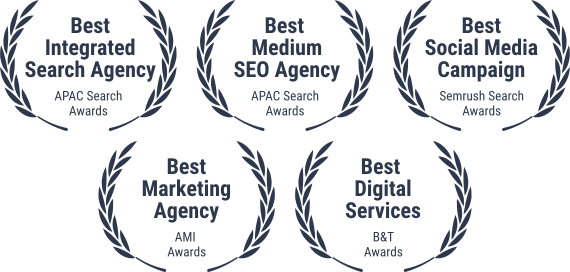
Joe has been on the pod before, as mentioned. He’s Head of SEO and AI Optimisation at Rocket. Under his leadership of SEO, Rocket has picked up some awesome industry recognition, including Best Integrated Agency at the 2026 APAC Search Awards and Best SEO Agency at the 2024 APAC Search Awards.
Joe, you’re very much at the forefront of Rocket’s response to how AI is reshaping search, what our position is, and how we’re helping clients navigate the changing landscape. You and your team have been doing some awesome research into what’s happening in the market, which I think is fantastic for the industry within Australia and obviously great for our clients.
The reason we’re having this conversation today is because we held a webinar two days ago. It was the second biggest webinar we’ve ever held at Rocket. We had over 800 in-house marketers from around Australia register for it, and the topic was AI Search in Australia in 2026.
On the back of how popular that session was, we thought it would be good to have a conversation on the pod. We’re not going to run it like a webinar because that would be pretty dull. We just want to have a conversation around the key themes from the session.
The webinar itself was broken into two core areas. The first was the state of AI search in Australia in 2026, which was based on a lot of research Rocket has been doing into what’s actually happening with Google, ChatGPT and the major platforms. The second part was helping in-house marketers understand how to rank and drive visibility within large language models, ChatGPT, AI Overviews and Google’s AI Mode.
Joe, as a logical starting point, it would be good to kick things off with the State of Search report that you and the team have put together. Could you talk a little bit about the methodology and process the team went through to give Australian marketers a clearer understanding of what’s happening?
I think there’s often a lot of research coming out of North America and, to a lesser extent, Europe. Sometimes the data doesn’t quite reflect the Australian market. Even a lot of the reports we do get access to only tell part of the story or are vendor-funded, so they come with a pretty heavy bias one way or another.
It would be great if you could speak to the research you and the team have been doing.
Joe Alder: Yeah, sure.
The research was basically split into two different sections.
The first section involved analysing over 150 Australian businesses where we have access to Google Analytics data. That gave us really accurate data across a very wide range of industries. Once we averaged the data, we could clearly see how the broader metrics were changing.
From an AI perspective specifically, we were able to see how much AI traffic had grown on average across over 150 Australian websites.
We could also see the split between the different tools. There have been lots of discussions around whether ChatGPT is still the dominant player, or whether people are now moving towards Claude, Gemini and others. We were able to get some good information around that.
A lot of existing studies use clickstream data, which monitors people’s web usage through browser extensions. That misses a lot of information when people are using mobile apps. So our data definitely isn’t perfect, but I think it gives a really strong view of the landscape.
The second part of the research looked at the overlap between LLMs and Google, primarily AI Overviews and Google, but also ChatGPT and Google.
There’s been a lot of discussion saying ChatGPT search and Google search are basically the same thing and use the same techniques. There have also been studies showing very low overlap.
I really wanted to design a study that looked at this from multiple angles and also took into account how people search differently on each platform.
For example, the average Google search might be three to four words. In ChatGPT, it’s more like six to eight words. If someone is searching for a digital marketing agency, they might just type that into Google. In ChatGPT, they’re more likely to ask, “What is the best digital marketing agency for a B2B business?”
There was a lot of work behind the scenes understanding what terms should be tracked on each tool. From there, we were able to generate the overlap statistics.
James Lawrence: I think it would also be good to speak to the sheer volume of data.
Obviously, one part of the study focused on Rocket clients, which naturally introduces some bias because those clients are investing in SEO and digital marketing. I’d like to think it’s good work, but there’s still bias there.
But beyond that, the amount of data points and research that went into the broader study was huge.
Joe Alder: Yeah. We basically looked at every possible variation.
We checked every major AI tool to see whether there were correlations between ChatGPT, Gemini, Claude and others.
For ChatGPT specifically, because every search response is slightly different, we performed anywhere from 10 to 100 searches per prompt.
Across the entire dataset, we looked at around 4,500 industries and sub-industries in Australia, and the total number of data points exceeded one million.
I think there were around 700,000 prompt responses alone that we analysed.
James Lawrence: Yeah, and I think what’s really interesting is seeing the trends over time and then comparing those findings against international studies we’ve traditionally relied on.
There’s definitely overlap, which is reassuring because it suggests the data is directionally accurate.
Jumping into some of the insights, when we framed the webinar, I spoke a bit about the macro landscape. This really is the biggest shift in digital in 20 years.
The way behaviour is changing is dramatic. The data we’re seeing shows that 49 percent of Australians are using large language models monthly.
That number might surprise some marketers because, if you spend too much time on LinkedIn, it feels like everyone is using AI constantly. But when you narrow it down to knowledge workers, that jumps to 78 percent.
Then there’s the APAC B2B Buyer’s Guide research from late last year showing that 93 percent of B2B buyers are using AI during the purchase journey.
So whether people realise it or not, Australians are using these tools to find answers and evaluate brands, and it’s clearly impacting the buyer journey.
Joe Alder: Yeah, absolutely.
James Lawrence: In terms of market share between the different large language models, what are we seeing?
Joe Alder: We looked at this in two ways.
The first was using StatCounter data, which I cross-referenced with a number of third-party tools and some of my own research. It felt like the most accurate representation of market share currently available.
ChatGPT was sitting at around 68 percent market share. That’s down from around 85 percent this time last year, so it has definitely lost market share to competitors.
Copilot has grown massively. Gemini, Perplexity and Claude have all grown strongly too. Claude had one of the biggest percentage increases, although it started from a much smaller base and still only sits around six percent market share overall.
But market share doesn’t necessarily equal website traffic.
When we looked at actual traffic referrals across our own dataset, ChatGPT dominated. Around 88 percent of AI traffic to websites came from ChatGPT.
Gemini was around 6.6 percent, Perplexity around three percent, and Claude barely registered at around 1.5 percent.
So while overall usage across tools has diversified, ChatGPT remains overwhelmingly dominant when it comes to actually driving traffic to websites.
James Lawrence: Is that mainly because people use different tools for different reasons?
Within the marketing industry, Claude has become really popular in the last six months, particularly for coding, analytics and workflow tasks. But consumers searching for products or services still seem to default to ChatGPT.
Joe Alder: Yeah, exactly.
People are using different tools for different tasks.
Someone might use ChatGPT personally, while also using Claude or Copilot at work because their company has invested in it.
I also think some of these tools are just not very good for search.
Even Gemini, which is backed by Google, can be pretty clunky from a product discovery perspective. It’s not always obvious where links go or what source is being referenced.
ChatGPT is still doing the best job from a consumer search perspective.
Perplexity is obviously search-focused, but interestingly, its usage actually declined slightly year over year in our data.
James Lawrence: One of the biggest questions marketers have is around Google. Are people using it less? Is traffic dropping because Google is dying? What’s actually happening?
I think the research Rocket has done here is some of the most useful.
Joe Alder: Yeah. In terms of “Is Google dying?”, I would say definitely not.
Google just released its Q1 earnings report and search revenue was up 19 percent year over year.
Across our clients, we actually saw impressions increase by around 43 percent. That means businesses are appearing in more searches than before, and there are more searches happening overall.
Other industry studies have estimated total Google search volume is up around 20 percent, which aligns with what we’re seeing.
That said, traffic from Google Search is falling.
There’s a major distinction there. More people are searching, but fewer people are clicking through to websites.
MarTech published research earlier this year showing the average website had lost around 35 percent of traffic.
Across our client base, despite strong rankings and increased impressions, we still saw an average 2.5 percent decline in clicks year over year.
And publishers have been hit much harder.
Daily Mail Australia lost around 2.5 million readers year over year. Business Insider and several major publishers have also seen significant declines.
James Lawrence: I think it’s important to stress that Rocket is platform agnostic. Our focus is simply helping clients reach the right audience.
I was at Google Australia yesterday speaking with a very senior member of the team, and the mood there is incredibly confident compared to 18 months ago when everyone was talking about “code red” for Google.
It feels like Google had this technology for a long time but was reluctant to release it because of the risks around hallucinations and accuracy. Once OpenAI forced the market open, Google was able to move aggressively.
There’s no doubt AI Overviews are having a huge impact on businesses that relied heavily on informational content and publishing traffic.
Joe Alder: Yeah, definitely.
I think the key thing is that ChatGPT and the other tools are only taking a small amount of search traffic directly.
The bigger impact is Google’s response to them.
Google introduced AI Overviews to stop users leaving the platform for ChatGPT. The result is that users often get their answers directly within Google without needing to click through to websites.
We found that when an AI Overview appears, clicks to the number one organic result drop by around 58 percent.
At the same time, AI Overviews themselves have expanded rapidly.
Last year, they appeared in around 10 percent of searches. Now they appear in around 30 percent.
That’s a huge change in a relatively short period of time.
James Lawrence: I think you’re right. Google rolling this out so aggressively isn’t just a short-term play. It’s clearly about protecting user behaviour and keeping people within the Google ecosystem.
My little boy was sitting next to me on the couch recently and said, “I love the way Google gives me these overviews now.” You can literally see how behaviour is changing in real time.
And to Google’s credit, it probably has slowed some of the migration towards ChatGPT.
Joe Alder: Yeah, 100 percent.
James Lawrence: So then the next logical question becomes, if Google is still dominant and AI tools aren’t driving huge amounts of traffic directly, why does this matter so much?
Joe Alder: I think that’s a really important point.
If you spend too much time on LinkedIn, it can feel like Google is dead and ChatGPT is now driving all internet traffic, but that’s definitely not the case.
When we compared traffic coming from Google and traditional search engines versus AI tools, all AI platforms combined generated around 1.24 percent of traffic.
Ahrefs also published research showing Google sends around 200 times more traffic to websites than AI tools do.
So on the surface, it might seem insignificant.
But I think that’s only the visible part of the iceberg.
The issue is that traffic has always been the way marketers measured influence. In AI tools, influence works differently.
The click-through rate from ChatGPT is extremely low. If someone asks ChatGPT for the best running shoes, only around one percent of users will actually click a link.
What’s happening instead is that people are using AI during the research phase and then validating those answers elsewhere.
Semrush released research showing 77 percent of users are using both Google and AI tools together.
About 68 percent of users go to AI first, then validate via Google.
So AI is heavily influencing the buyer journey even if it’s not directly driving clicks.
James Lawrence: And I think that’s the really important takeaway.
Initially, marketers saw traffic declining and assumed ChatGPT was taking it. That’s not really what happened.
The decline in traffic is mainly because of AI Overviews and Google keeping users inside its own platform.
But the rise of AI influence is absolutely real.
The issue is that digital marketing has spent the last 20 years obsessing over traffic and conversion rates. That’s not really how these tools work.
The key statistics matter again here. Forty-nine percent of Australians are using AI monthly. Seventy-eight percent of knowledge workers are using it monthly. Ninety-three percent of B2B buyers are using it during purchasing.
If your brand isn’t showing up in those conversations, you’re losing influence whether you realise it or not.
I thought the Optus example from the webinar was really interesting too. Maybe you could talk about that.
Joe Alder: Yeah, definitely.
We have a deliverable where we analyse how ChatGPT and other LLMs perceive brands.
If someone is researching mobile providers, what narrative is the AI returning?
For Optus specifically, when we looked at comparisons and recommendation-based prompts, the sentiment was negative around 72 percent of the time.
So if someone asked ChatGPT who they should use for their mobile plan, ChatGPT was frequently responding with concerns around customer service, network reliability, trust issues and regulatory concerns.
If consumers are increasingly using AI tools during purchasing decisions, then that absolutely impacts market share.
James Lawrence: There was another example from the webinar where we asked if a particular brand would be recommended and the answer was literally “No.”
That’s what makes this so important.
So then the obvious question becomes, how are we helping clients manage and improve this?
Joe Alder: Everything starts with measurement.
One of the biggest challenges with AI search is that there are very few native reporting tools.
There’s no equivalent of Google Search Console for ChatGPT.
So the first thing we do is model likely search behaviour.
We look at traditional SEO data and then estimate how users are likely to phrase those same searches within AI tools.
Once we have those prompts, we track them daily.
For example, we might run the same prompt 100 times per day because responses vary every time.
Unlike Google, where rankings are relatively fixed, AI visibility is probabilistic.
The key metric becomes share of voice. Out of 100 prompts, how often is your brand appearing versus competitors?
That’s really the gold standard for AI visibility measurement at the moment.
James Lawrence: We’ll include a link to the webinar in the show notes because Joe walks through examples of the dashboards we’re building for clients.
We never overly promote Rocket through the pod, but if marketers are struggling with AI visibility, measurement or optimisation, feel free to reach out because it’s an area where a lot of businesses are still trying to work things out.
Joe, let’s shift into optimisation itself.
How do businesses actually improve visibility in large language models? Is it just traditional SEO or is it genuinely different?
Joe Alder: I think there’s definitely overlap with SEO foundations, but the way the platforms work is very different.
AI Overviews are still very closely tied to Google rankings.
If you rank number one on Google, there’s around a 60 percent chance you’ll appear in AI Overviews.
Top 10 rankings had around a 43 percent overlap.
So AI Overviews behave relatively similarly to Google.
ChatGPT is completely different.
When we compared ChatGPT results to Google’s top 10, there was only around a 15 percent overlap.
About 80 percent of ChatGPT citations weren’t even present in Google’s top 10 results.
So the overlap between the systems is actually very low.
James Lawrence: That’s the bit I find frustrating when people say GEO is just SEO.
The data clearly shows it isn’t.
If only 15 percent of top Google rankings overlap with ChatGPT citations, and 80 percent of ChatGPT sources aren’t even in Google’s top 10, then the platforms are clearly synthesising information very differently.
It absolutely requires a different approach.
Joe Alder: Yeah, definitely.
The foundations are similar, but the tactics and priorities are different.
James Lawrence: Let’s talk technical optimisation first.
What are the technical things businesses need to get right?
Joe Alder: The most basic thing is making sure AI tools can actually access your website.
We’ve had clients where Cloudflare or security tools were blocking AI bots without realising it.
If AI crawlers can’t access your content, you won’t get indexed.
There are also situations where AI tools are being rate-limited because the site interprets them as malicious traffic.
One really easy way to test this is asking ChatGPT to read the final line of text on a webpage. If it struggles or hallucinates, there may be access issues.
Site speed is also incredibly important.
If your website takes more than four or five seconds to load, ChatGPT often just abandons it and moves on to a competitor.
James Lawrence: There was also that legal client example from the webinar where relatively simple technical fixes drove huge improvements.
Joe Alder: Yeah. We saw around a 200 percent increase in AI visibility in three months just by fixing crawler limitations.
The AI tools technically could access the site, but they were getting blocked and rate-limited by security systems.
A lot of businesses simply haven’t checked this yet.
James Lawrence: Schema is another interesting one.
ChatGPT itself doesn’t seem to rely heavily on schema, but other AI tools definitely do, and it’s still best practice from an SEO perspective.
Joe Alder: Yeah, exactly.
James Lawrence: Any other practical technical tips?
Joe Alder: One really useful thing is testing agent mode.
Ask ChatGPT to complete a purchase or enquiry on your site and watch how it behaves.
You’ll often uncover issues very quickly.
Google also recently released documentation around optimising websites for agents, so this is definitely becoming more important.
James Lawrence: Nice.
Moving onto copywriting then. What are we doing differently from a content perspective?
Joe Alder: The first thing is quality.
There’s so much AI-generated content flooding the internet now that genuinely unique content stands out massively.
Instead of publishing 10 generic blogs, it’s much more effective to publish one strong research piece with original data or insights.
The second thing is understanding how ChatGPT behaves.
It acts like a user researching a topic. If someone is buying a car, ChatGPT will look at reviews, comparisons, feature breakdowns and other supporting information.
So businesses need to think about all the surrounding questions users might ask and build content around those.
Content pillars work really well for this.
Also, ChatGPT is lazy. It heavily prioritises headings and early-page summaries.
Adding concise summaries and clear answers near the top of pages really helps.
James Lawrence: I think that’s such an important point.
The old model of writing average 500-word SEO blogs stuffed with keywords is basically dead.
The demand now is for genuinely useful, high-quality content.
That’s why our copy team has actually grown despite AI becoming better at writing. There’s more demand for quality, not less.
What about specific content types?
Joe Alder: Listicles work very well because they answer multiple related questions quickly.
Comparison content, pros and cons content and FAQs also perform strongly.
Anything location-specific is increasingly important too because AI tools personalise heavily based on user context.
If someone is searching from Sydney, localised content is far more likely to surface.
James Lawrence: Nice.
Then the final pillar is authority and brand.
What’s changed there?
Joe Alder: What happens off your website is now more important than ever.
In traditional Google search, users usually visit your website directly.
With AI tools, there’s no guarantee they’ll even look at your site.
So every external source matters.
Wikipedia, social profiles, review platforms, citations, industry mentions and forums all become incredibly important.
We’ve had cases where AI tools were confusing clients with entirely different businesses because the external signals were messy.
Sometimes a simple citation fix completely changes how the AI interprets the brand.
James Lawrence: It really feels like authority signals have been supercharged.
Joe, thanks so much for coming onto the pod today.
I thought we’d finish with a rapid-fire round.
Biggest ranking factor in AI search right now?
Joe Alder: External sources and citations.
James Lawrence: Most overrated SEO tactic in AI?
Joe Alder: Over-optimising specifically for AI Overviews.
James Lawrence: Brand or backlinks?
Joe Alder: Brand.
James Lawrence: Leading AI search platform today?
Joe Alder: ChatGPT.
James Lawrence: Biggest mistake marketers are making with AI?
Joe Alder: Not monitoring it properly.
James Lawrence: One metric that matters most?
Joe Alder: Citation share versus competitors.
James Lawrence: Final advice for in-house marketers?
Joe Alder: Don’t ignore this channel.
At minimum, build some reporting around it and understand how your brand is being perceived online because that’s only becoming more important.
James Lawrence: Great answer.
Joe, thanks so much for coming back onto the pod.
Joe Alder: Awesome. Thanks, James.