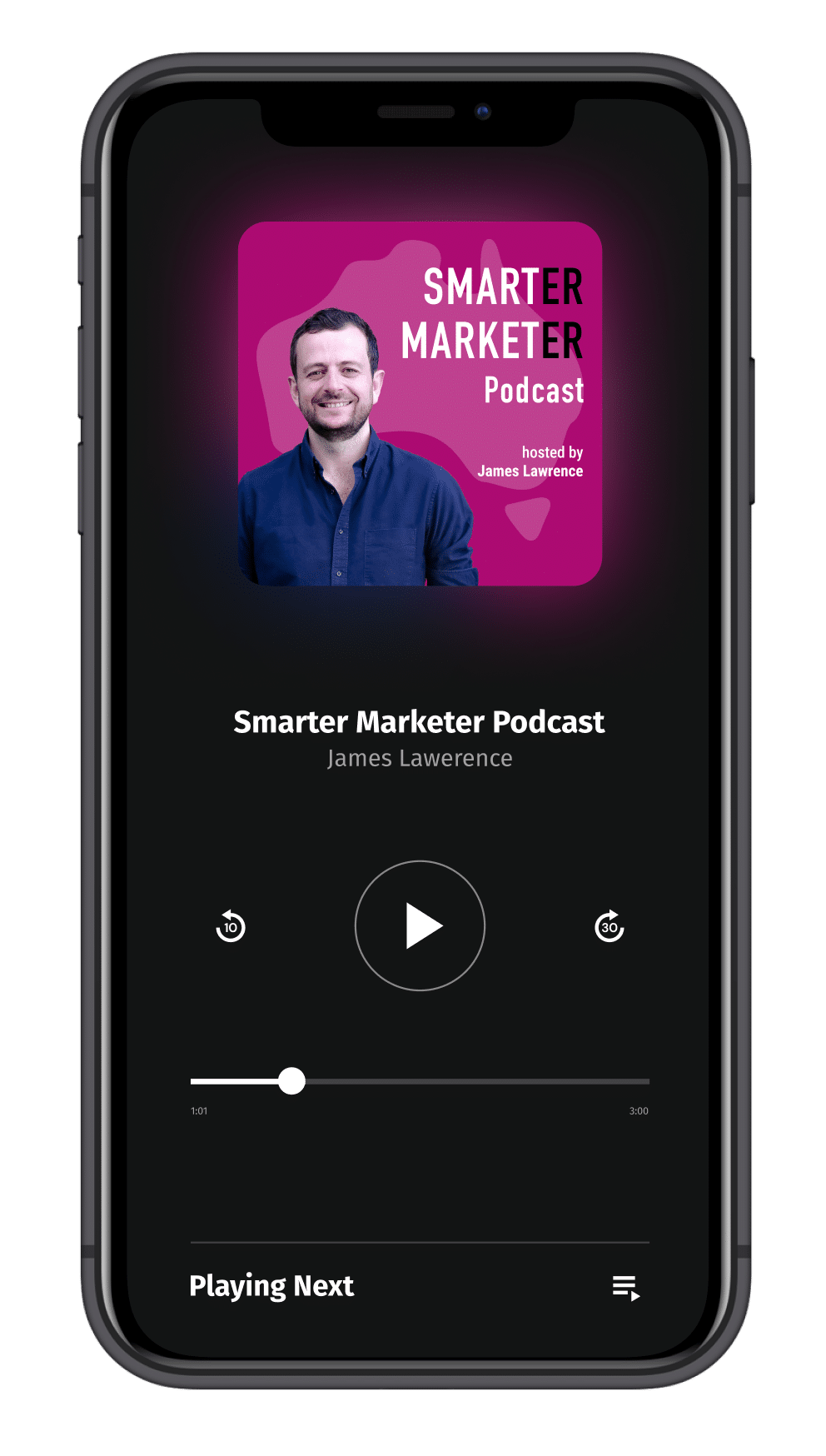
Digital Marketing in Australia in 2026
- Your Questions Answered

Episode Description:
What would great marketing look like in Australia this year, especially when the rules are changing faster than most teams can keep up? In this episode, Rocket Agency’s top experts unpack the biggest shifts shaping digital marketing in 2026, from AI search and zero-click behaviour to rising costs, evolving content expectations and the growing importance of creative.
Host James Lawrence discusses marketers’ most pressing questions with Mariano Di Lascio (Head of Digital), Joe Alder (Head of SEO), Leesa Mealing (Digital Creative Lead) and David Lawrence (MD). What follows is a practical, honest look at what’s working, what’s not and where marketers should be focusing next.
Key Takeaways:
- Key trends shaping the Australian marketing landscape this year
- If zero-click search continues to grow, how should marketers measure SEO success differently?
- With AI-generated content flooding the internet, what does “good” content look like now?
- One AI use case that’s genuinely delivering ROI?
- With CPCs rising and competition intensifying, what are the first three levers you’d pull before increasing budget?
- If you’re leading marketing in 2026, what are you actually automating with AI, and what are you deliberately keeping human?
- LinkedIn for B2B: are most brands under-investing in creative, targeting, or measurement?
- Is the funnel broken or are marketers just running the same message at every stage?
- If you’re a lean team with limited budget, what’s the one channel and one capability you would prioritise this year?
- With Meta and Google controlling audience data, how much should brands invest in building owned channels right now?
… and more pressing questions.
Meet James Lawrence
Host, Smarter Marketer Podcast
Co-Founder of multi-award-winning Australian digital marketing agency Rocket, keynote speaker, host of Apple #1 Marketing Podcast, Smarter Marketer, and B&T Marketer of the Year Finalist.
James’ 15-year marketing career working with more than 500 in-house marketing teams and two decades of experience building one of Australia's top independent agencies inspired the release of Smarter Marketer in 2022, the definitive podcast for Australian marketers. The show brings together leading marketers, business leaders and thinkers to share the strategies that actually move the needle.
Each episode offers candid conversations, hard-won lessons and practical insights you can apply straight away.


James has delivered keynotes at:


Mariano Di Lascio, Joe Alder,
Leesa Mealing & David Lawrence
Rocket Panel
About the Guests
Mariano Di Lascio leads a team of outstanding marketers at Rocket Agency across paid search and paid social channels. Together with the team, he has won some outstanding awards for client campaigns, including Best Integrated Campaign at APAC Search Awards, Best Integration of Search into Cross-Channel Marketing at Search Engine Land Awards and Best Integrated Campaign at Semrush Awards.
Joe Alder is an award-winning SEO expert and has driven organic growth for global brands like Amazon, Coca-Cola, ANZ and Dulux through innovative strategies and data-driven insights. With over 20 industry award nominations, Joe is recognised as a leader in the field.
Leesa Mealing is the Digital Creative Lead at Rocket, bringing over 15 years of experience across creative direction, art direction and design. She blends big-picture thinking with hands-on execution, shaping concepts while staying close to the work. Her background spans everything from branding and packaging to UI/UX, content and campaign production, and she’s just as comfortable leading a shoot as she is refining the details on screen.
David Lawrence is the MD and Co-Founder of Rocket, an award-winning Australian full-service digital marketing agency. He is also the co-author of the Amazon #1 best-selling marketing book, Smarter Marketer. David has presented at several events, including Inbound Boston, Search Marketing Summit, Mumbrella360, CEO Institute, and various seminars and in-house sessions.

Transcript
James Lawrence: Welcome back to the Smarter Marketer Podcast. Today’s episode is a slightly different one. Essentially, Rocket ran a webinar late last month on digital marketing in 2026: your questions answered.
We had hundreds and hundreds and hundreds of marketers from around the country register. It was one of the more subscribed-to webinars that we’ve hosted. In the signup process, marketers were allowed to submit questions.
In terms of the structure of the webinar, we’ve edited it down to podcast form. We took the questions, and our team pulled together consistent themes. We were able to reduce what was a very large number of questions down to nine core themes, which we then had the Rocket team answer in different capacities, depending on the role of the people on the webinar.
From that, we then had live Q&A happening throughout the webinar session, which you’ll be able to hear. Then we collated a large number of questions that were quite tactical in nature, and we described that as a rapid-fire round at the back end of the webinar, where we kind of went through a large number of questions in a very short space of time.
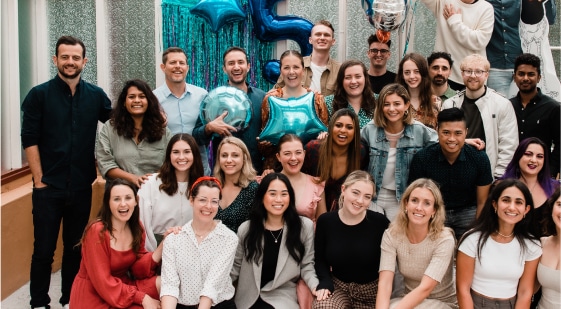
So I hope you enjoy this slightly different version of the webinar. The team will be introduced very shortly as I introduce them on the day in the webinar. But essentially, we have Rocket’s two co-founders, myself and David. We have our Head of Digital, Mariano, our Head of SEO, Joe, where there were a lot of questions around AI search, the impact of ChatGPT, and changes in the Google landscape. We also had Lisa, who is our Digital and Creative Lead.
I hope you enjoy the episode.
Welcome to Rocket’s Digital Marketing in 2026 webinar: your questions answered. We’ve had an awesome response to this webinar. We’ve had hundreds and hundreds of marketers from around the country sign up and register. We were blown away by the number of questions we received. I think it was close to a hundred questions that came in.
In terms of the agenda today, I’ll quickly do a meet-the-panel and introduce you to everyone. I’ll do a very quick overview of Rocket, not at all to spruik, but I think it’s important for you to understand the type of work we do and who we do it for, because it does give context as to our view on digital marketing in 2026.
I’m then going to, based on the questions that came in, put some thought into it. I felt there were five areas that I wanted to cover very quickly. It’s about six slides, but I think it’ll give good data and context to some of the questions that we received.
Then we’re going to jump into the guts of it, which are the questions being answered. So we’ve broken it into three core areas. The first one is we went through all of the questions we received, and we were able to distill almost half of the questions into nine overlapping or very similar questions. So the first part of the session, I’ve got those questions lined up one per slide, and we’ll go around the room with the panel and get our views on that.
In terms of the panel today, I’m James Lawrence, co-founder of Rocket. Mariano essentially leads the entire digital team, so overseeing our paid media teams, our social teams, our SEO team, et cetera. I’ll now go ahead to Joe Alder, who’s Rocket’s Head of SEO.
So essentially, Joe oversees SEO, but also AI optimisation, and is responsible for the team members, making sure that they’re doing everything we need and ultimately responsible for client results in organic. Joe, welcome to the webinar.
We have Lisa Mealing, who is Rocket’s Digital Creative Lead, so essentially responsible for the output of our design team.
And then we have David Lawrence, who is my co-founder at Rocket and our Managing Director. Dave, you don’t always come onto these types of things, but in terms of the questions that we received today, I think there were some overlapping themes around use of AI and professional development for marketers. Dave’s role within our business is very much on our people, so making sure we’ve got the right people in the organisation, that they’re growing, training, and doing all the things we need them to do. So I thought it’d be good to get your perspective and commentary on some of those questions.
We’re lucky enough to do the digital marketing for Urban Surf, where Dave spends most of his working week, and then spends the rest of it watching videos of himself surfing that have been captured.
It’s strange stuff. We’ll push through.
So, very quickly about Rocket. We’re a full-service digital marketing agency founded in 2017 here in Surry Hills in Sydney. Head office is still in Surry Hills. We also have a presence in Melbourne, but very much do work with clients all across Australia and New Zealand.
I think we just ticked over 65 full-time staff members, and we’re independently owned by Dave and myself. I think that does matter. I feel that digital has changed so quickly in the past two years, and faster than probably any time in the last two decades. I do believe that being an independent agency allows us to move really quickly and respond to things as they change.
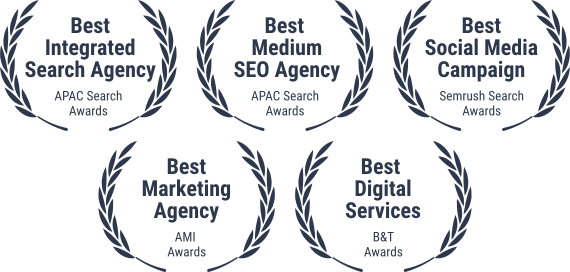
The obligatory award slide: I’m really proud of some of the ones that we landed two weeks ago. So, at the APAC Search Awards, which were held two weeks ago, and which are very much awards for all of Asia Pacific, with lots of bigger agencies and also smaller independents, we picked up Best Large Integrated Agency, which was the final award on the night, which we were absolutely ecstatic about.
Also Best Large PPC Agency. So I think that’s good context for the content, in the sense that the team are doing really good work at the moment. So I do believe we are at the bleeding edge of change within our space.
In terms of the areas where we specialise, we break it down into four buckets.
The first one is SEO and now AIO. So essentially, driving organic performance for clients.
The second bucket is Google Ads, so that’s the entire Google suite: search, YouTube, display, shopping.
Digital media, so for us, that includes social channels, Facebook, Instagram, TikTok, but also programmatic media buys, which are increasingly becoming blurred between online and offline, but basically for us are all digitally bought.
And then the fourth one is a huge one for us, and an area where we’ve invested really heavily in the last three to four years. To get those first three channels moving now, you need to have awesome creative. So for us, we’ve built a really successful creative agency within the agency: designers, copywriters, illustrators, strategists, but essentially making sure that we can get the assets to help clients drive performance. So whether that’s landing pages, videos, website work, video branding, whatever it might be, but essentially getting creative moving for our clients.
In terms of the types of clients we work with, generally for us it’s the upper end of SME into mid-market. So there are some big logos there. We do work with some smaller brands as well. I think the consistent theme for us is that we work with reasonably small marketing teams to help them get the most out of digital. So for us, that’s in-house marketing teams of one through to probably 10 to 15. And generally it’s about us coming in and bringing digital expertise and acumen, which allows the in-house teams to get on with the very broad range of things that in-house marketing teams are expected to deliver on these days.
And then the last slide about us, just to make the point that we have really deep relationships with the big platforms here in Australia and across APAC. So Meta Business Partner, we’ve been a Google Premier Partner since that program started, we’ve been a TikTok partner since they launched in Australia, and last year we were the first digital marketing agency to become an OpenAI partner. So we’ve got really strong relationships with all of the platforms, which I think does help us to move quickly as things change.
So that is enough about Rocket. I just wanted to cover these five trends, which I think will segue nicely into the questions.
It’s probably no surprise, but AI search is growing fast. I don’t want to shame Rand Fishkin, who we’ve had on the pod quite a few times and who is excellent, but he was on our podcast a few years back and he basically was saying ChatGPT gets one out of every 373 Google searches — don’t worry about it too much. And that was true at the time. But he’s subsequently rolled that back, saying that AI search now makes up 25% of queries around the world. And that’s what we’re seeing in Australia. So one in four queries that used to go to traditional search are now happening within AI, and with ChatGPT and within Gemini and Google’s own AI properties.
It’s a huge theme for today, and I think it’s good to put some numbers around it. Roughly 25% of queries are now happening within AI.
In terms of market share in Australia, ChatGPT is the gorilla in the room, although Q4 last year did see Gemini pick up some pretty strong market share within that particular market. So I think it’s just good to put some context around that.
In terms of traffic coming out of AI, and Joe will speak to it pretty soon, we did a big research project taking all of our client data from 1 January 2024 through to the end of June 2025, and traffic coming out of ChatGPT was converting 5.1 times better than traffic that was coming out of traditional search.
So the buyer journey is changing quite radically. It depends a lot on your particular market, but it’s not uncommon to see less traffic coming out of Google, ChatGPT, et cetera, but the traffic coming out is much higher quality. So that’s something which is a huge theme. If that’s what you’re experiencing, you’re not alone there.
This is an important one. We probably fell into this camp when things started, which was: to do good AI optimisation is basically just doing good SEO. That was a narrative that was coming out of the SEO industry in the early days. It’s proven itself not to be true, where results in AI are working very differently to how results appear in Google.
These are two stats that we pulled out of IPRank and also Ahrefs, and we’ll link to the Ahrefs article being referenced. But essentially, you’ve got a 25% chance of appearing in AI if you rank in Google’s top 10 for a similar query. So it’s not a huge overlap.
And this one is fascinating: 28% of ChatGPT citations literally don’t exist in Google’s index. It’s not that you’re not in the first 10 pages — it’s literally that a quarter of the type of things that ChatGPT is referencing just simply don’t appear within Google.
So the way we look at it is there are massive overlaps with the types of levers you pull to appear well in SEO, as you do in AIO. But just doing SEO is not enough to rank well within Google AI Mode, within AIO overviews, and within ChatGPT.
So I think it’s something that there are lots of misconceptions out there about at the moment.
This one’s kind of unrelated to that, but we find that a lot of brands are discounting TikTok. I have this saying here that TikTok has grown up. 12.5 million Australians use TikTok on a monthly basis, and that number’s jumped up quite a lot. Even a couple of years ago, it was more like seven to eight million.
The average age is 33. I think there’s this misconception that the average age on TikTok is teenagers scrolling after school. A quarter of TikTok users in Australia are over 35.
And this is the interesting stat for me: 86% of 15- to 29-year-olds that use TikTok use it as their search engine on a weekly basis. So there is this kind of cohort coming through that, for them, social search is their search engine.
So depending on the calibration of your channel mix, we’re often seeing a lot of brands probably have a massive blind spot within TikTok.
And then this is the last of the points before we jump into the Q&A. Creative is your biggest performance lever when it comes to maximising your media. Often there’ll be this over-indexation on audience targeting and context and reach and impressions and all these things, which are really important. But often it’s creative which is the biggest lever.
And this is based on a huge Nielsen study where they keep doing it and it keeps showing the same thing. And we would see that here at Rocket, which is there’s this thinking that all media buyers are equal, but it’s just not how it works. You need to have excellent creative in order to get the performance that you want these days.
So it’s also often a blind spot, which we’re trying to get clients to think more of, particularly prospective clients.
As I said earlier, we basically received a huge number of questions that you submitted as you came through to join the session today. We went through, and there was some really heavy overlap, particularly with some of the topics of most interest. So we’ve taken a question that we think is most indicative of the sentiment or the rationale behind the questions and connected them through.
In this section, we’ll go through these questions.
So the first one, which I’m going to send across to you, Joe, is: if zero-click search continues to grow, how should marketers measure SEO success differently?
And I’m pretty happy for you to broaden that away from just zero-click on the Google search results page. I think if that relates to AI search and that very real behaviour we’re seeing of people doing a lot of interaction within large language models before they come out, if you could just speak to that measurement piece and what we’re seeing at Rocket.
Joe Alder: Yeah, sure. So I think first off, the traditional metrics still are definitely important. Google is still the biggest driver of website traffic across the globe. So starting with that, there is also some overlap between AI tools and Google, and they also define some success in other ways.
But I think apart from that, there are no proprietary tools that exist. There’s no equivalent of Google Search Console to track how you are appearing in AI searches. They’re also incredibly personalised, and the click-through rate from AI tools is really low. So it’s around 1% for all searches and 3.5% for traditional searches.
So what that means is that you need to rely on third-party tools. We have a robust setup that we’ve done for our clients, and we basically track over a hundred terms per day and work out the average based on that of whether we are appearing for those brands, and then also if they’re appearing positively, because there is a lot as well where sometimes you’ll search for a brand and it’ll appear negatively.
So I think that’s the most important thing, just making sure that you are having these third-party tools set up. You have a GA filter set up as well to work out that click-through-rate traffic.
James Lawrence: I think, just to add to that, Joe, it depends a lot on the strategy clients have had around content generally, and also the vertical they’re in. But it’s definitely the case that we’ve got lots of clients where their traffic from organic has continued to grow as it did prior to AI, but definitely some clients where a lot of that kind of top-of-the-funnel content is driving less traffic than it once did.
But it shouldn’t mean that your actual bottom-of-the-funnel commercial outcomes are being impacted, if that makes sense. So I think it is important — the funnel’s kind of done to death, but it still is important to measure along it in terms of the output at the very end not being impacted. Fair to say, Joe?
Mariano Di Lascio: Yeah.
James Lawrence: There was a big Ahrefs study that Joe shared internally with the team, and it was looking at traffic flows across the web over the last few years. Organic traffic, I think, was down slightly, very slightly, but direct traffic to websites was up massively. I think it was 10% higher than what it had been previously. And I think that is something that you need to keep an eye on. Then social, et cetera, were very comparable year on year.
The next one is: with AI-generated content flooding the internet, what does good content look like now? Lisa, I might go to yourself there, working in the creative team with a whole bunch of people responsible for creating content. What are your thoughts on this?
Leesa Mealing: Yeah, sure. So firstly, defining content — we’re looking at not just imagery, but text as well. And I think AI is awesome to have as a sort of jumping-off point for concepting or even writing captions, but you can’t fully trust it.
As we see, it’s fully infiltrated the market in social spaces and websites, pretty much across everything. People are also getting really good at spotting what bad content looks like, or what we call AI slop.
And I think there’s a sort of balancing act here where you have that element of human interaction. So sense-check what you know. If you’re using it for copy, definitely sense-check it. You can always remove those long dashes — that’s a dead giveaway that it’s AI content.
And if you’re looking at imagery, that’s a really tricky point because oftentimes it’s usually used to lessen your expenses on imagery, creating all those assets that you need. But one thing I will say, and I said this in our team meeting last week, is AI makes volume easy, but taste is what’s going to make the difference.
So knowing the difference between what a good image looks like and what is slop is a really good starting point. But honestly, if you can find that balancing act between authentic content and your own tone of voice, and having your own perspective and opinion, I think you’ll build trust a lot faster. You can integrate a little bit of AI with a little bit of human interaction. There’s just that sort of balancing act, though, that can make it difficult.
James Lawrence: I think it’s funny. I remember the first time I played with ChatGPT, I was like, “Oh my God, how do we have a copy team after this?” And you go through that journey really quickly. And then it drops away. You start to go, “Hang on, the tone, everything’s not quite there.”
And I don’t know — I don’t feel any threat anymore. It’s a tool. It helps so many members of our team do work faster, but generally it’s to do better. And I think for me, all the things we’ve been saying pre-AI around what good content is — it’s authentic, people know that you’ve got a perspective, you’ve got a position, it adds value to their life — those things are just as true now.
So I think, use AI to help you get your content quicker and better. But I don’t know — I think we employ more staff members now. We have more head hours attached to creating content for our clients than we did pre-AI. I think it’s just a tool that is really fast to average, but that’s not necessarily a bad thing.
That’s good feedback.
This one, I think, is really an interesting one, and I’m going to go around the room here because I think the way that we use AI as marketers, or the way we’re using it for our clients, is very different depending on our role.
There were a couple of questions like this, and I think a specific use case — because there are so many hype merchants out there talking about how amazing AI is, and then people use it and find it isn’t helping.
So I’m going to go around the room. If I can just get one thing that they’re doing as a professional marketer, or for their clients, that actually genuinely delivers ROI. I’ll go, Dave, to you first.
David Lawrence: Yeah. My one is using AI as a really smart and really fast colleague. That’s where I see it underused the most, where people go to it almost as a second action rather than going to it as a first action.
So, back to probably what Lisa said, if I’m working on anything, I’m going to AI really quickly to help with idea generation, quick drafts, quick concepts, check my thinking — the same way I would if I had a really smart person sitting next to me and I’d say, “Hey, what do you think about this? Got any ideas? What can we add to it?”
Collaboration — that’s a proven model. If you want ROI and you’re not using AI like that, give it a whirl for the next week and you should see yourself getting faster and better.
James Lawrence: Yep. What about you, Joe?
Joe Alder: So I think the thing we’re using it for the most is definitely research. Previously, if we were writing content, which is obviously really important, we would have to manually do a lot of the research.
Now we can pull in from all of our competitors, any studies that have been done in the area, any white papers, even YouTube videos, and pull in all those insights from a hundred different sources. This then goes into our content to make sure, even when it’s human-written, that we have all that AI research backing it, and it gives us a lot more data we can then put into it.
James Lawrence: So, Mariano?
Mariano Di Lascio: I would say industry research because, as an agency, we have the challenge of understanding our clients’ industry, what they do, what others are doing. So I think we used to spend a lot of time, and clients’ time, on getting up to speed with their challenge.
And I think now it’s incredible how much preparation you can do through AI deep research to really understand the industry and be faster in terms of getting ready to help. I think it’s so important to understand the challenge to then develop a strategy that actually performs.
So I think it’s been a time saver. In terms of ROI, it’s hours of research saved just by leveraging AI.
James Lawrence: What about you, Lisa?
Leesa Mealing: I guess, just off even what Mariano said, it’s really helpful for understanding if we’ve got a brief and a client that’s quite unique. A lot of our clients can have very specialised services, and just understanding their services in a very quick way.
And the other flip side of that is actually in creating those assets that we do. Sometimes even something as simple as, “Okay, I need a gradient within this colour palette,” and I’ve put in the colour codes and it can generate something like that. From there, that could be the background asset to a whole design piece. But it’s just that starting point that I need, and it saves me that time of actually going through and testing and playing around with gradients. It’s just a jumping-off tool.
James Lawrence: Yeah, nice. I think for me, probably just in terms of not campaign-type work, but for me, voice prompting particularly. I find ChatGPT’s voice prompting just unbelievable.
I think everyone in the agency has access to Whisper as well, WhisperFlow, which is just — if you don’t prompt with voice, the time saving is out of control. Basically everything I write now comes through ChatGPT. All my emails will be ChatGPT-driven, which I think probably saves me like 30 to 45 minutes a day. Much faster, which is awesome. And obviously double-checking everything and still proofing it.
Jumping topics here: with CPCs rising and competition intensifying, what are the first three levers that you would pull before increasing budget?
Mariano, I know this sounds very much like a you question. What would you do if a client kind of — and I suspect this probably is a daily occurrence, right, or a weekly occurrence — a client would come to us with something like this. What would your thought process be?
Mariano Di Lascio: Yeah, so the first thing that we do is challenge the thinking in terms of, is that actually a problem, or is it just part of the context? Even with CPCs rising, performance can still be strong, because decreasing or increasing budget has to do with performance, not with cost of clicks.
So if you see CPCs rising, it doesn’t mean you need to slow down, because if it’s working for you, go harder. So it’s first challenging and understanding: is this a real problem, or is it just part of the context and there’s nothing we can do about it? So that would be the first part of the conversation.
Then there are usually three things that we actually do, which is finding wastage. And believe me, it’s very common. Especially when we onboard accounts, the first thing we do is cut all the wastage. Okay, cut all the fat, always. Don’t assume your account is running well, because it’s not the case.
Finding those clicks that don’t lead to anything, that clearly don’t lead to results, is one thing that you can do.
And the second one, which speaks to what you referenced earlier, James, is focusing on creative and message. The cost of the click is your vehicle, and it’s how are you using that click, right? Are you showing something that is worth paying attention to? Are you saying something that is relevant? Are you landing people to a helpful landing page?
Really understanding that actually good creative decreases cost per click, because what is rising is not the cost per click. Actually, technically, it’s the cost per impression. So you can offset the increasing cost per impression by delivering better creative and being more relevant.
So anything you can do on what am I saying, what do I expect, how do I say it, what do I show — is going to help you decrease your cost per click.
David Lawrence: That’s correct.
Mariano Di Lascio: And then the third one is the offer. Because if you’re paying for a click, then what do you offer after the click? Is your offer strong? Are you making the most of the people that do click? Because a lot of people focus on the vehicle and not so much on what am I actually offering? Do I have a strong product? Et cetera, et cetera.
James Lawrence: Yeah. I think particularly for people that have bought traditional media, often there is this idea that 10k of media is just worth 10k of media, and it’s just not how digital marketing works, right? There are so many levers to pull that aren’t increasing budget.
Okay, we’ll go to the next question. I know it could be seen as being similar to the previous one on AI, but I think there’s a subtle difference in there. So if you are leading marketing in 2026, what are you actually automating with AI, and what are you deliberately keeping human?
I might go, Dave, to you first.
David Lawrence: Yeah, it’s a really good question. I’m just going to take automating to mean using AI, not actually using an automated agent. But for me, you look at anything you’re trying to achieve, break it down into tasks. Some of those tasks might be things you don’t even do at the moment because you’ve never had time to do them.
But then for each task, just look at whether you’ll do a better and faster job, or whether the AI will do a better and faster job. In general, what I see in our own marketing is that a lot of the back-office preparatory sort of workflow stuff, AI is just fantastic at.
So I won’t go back over mentioning all the things we mentioned about first drafts and ideation and all that kind of stuff, but I’m absolutely using AI for that really heavily.
What I am keeping human is the assessment of how well the thing that I’m producing in my marketing is connecting with my customer. Because ultimately that’s all marketing is. It’s connecting with the customer and delivering value or entertainment. And at the moment, AI is not as good as a skilled person at doing that.
It can sound quite convincing, but it generally isn’t. So when it comes to the actual creative output, the actual taste decisions, strategic decisions, empathetic decisions, I’m keeping those very human. But anything I can do that’ll make it faster and easier to get to the point where I can make those great decisions, AI is a great tool for that.
James Lawrence: What about you, Mariano? I’d be curious, because your perspective will be quite different given the type of work that your teams are doing. So I’d be curious as to what you’d be looking at here as well.
Mariano Di Lascio: Yeah, in terms of where do I draw the line in terms of who does what, I’m very pragmatic and I usually like to test and see the outcome from AI and see, is this better than what I can do? So if the answer is yes, then that’s what drives the decision, because at the end what we want is quality.
So it is not about AI or us. It’s about who delivers the best outcome. And also on that, AI is evolving every day. So we need to continue to test. Okay, is there a new tool? Is there a new process? This didn’t work three months ago — let’s put it to the test again.
Then at the end, what I find is that today AI is really strong at data management, data synthesis, things that are very time-consuming and are not really valuable. We are using data a lot in better ways now, with AI consolidating GA4 data, platform data, client data, to understand patterns. So we are getting a better view of data from where we can think, which is a time saver and really valuable.
James Lawrence: And what about you, Lisa? I think creative is often where you jump into LinkedIn and see this incredible two-minute video that was created with a two-sentence prompt. How’s it actually working at the coalface? What are the things where AI is awesome, and the things where it’s, nah, we need awesome humans doing this?
Leesa Mealing: Yeah, so it depends on the tool, but most tools that we use at Rocket specifically, like Figma and Canva and even Adobe Suite, have elements of AI already in them.
So it’s awesome. What I tend to do, and I know the rest of our designers tend to do with design work, is we’ll still be designing that initial concept. We might use something in Figma called Auto Layout, which makes sure it shifts things to the best of its ability. But then again, we’re going to apply that human level of sense-check to make sure that visually works and it makes sense as you roll it out.
And then the other tool that is an awesome one to have is when you’re rolling out across multiple channels and you have one, especially if it’s a static ad or an animated ad, and you just need to quickly roll that into multiple sizes with no real changes. That’s when AI is awesome.
Figma has that function. I believe Canva has some functionality around there. The other one that Canva has, which is really handy for small businesses if you’re using Canva, is there are some animation tools in there that already exist within Canva. So if you’re not very good at animating, there are just some quick wins that you can get to have something that is a little bit more premium-looking and polished as a finished product.
James Lawrence: Yeah, that’s awesome. Good practical stuff in there, guys.
Next one is LinkedIn for B2B. Are most brands under-investing in creative, targeting, or measurement? I might go to you, Lisa, on this one to start with, and then Mariano, I think, get your perspective probably more from the actual media buying viewpoint.
Leesa Mealing: I think this is an interesting one because I think B2B, creative, LinkedIn — all those words almost don’t feel like they belong in the same sentence. But I think definitely people always think of B2B marketing as quite a dry space, and it can actually be done in an interesting way.
Again, we’re going back to finding that unique perspective, that tone of voice. You’re solving a problem that exists, and it’s probably familiar to other people. What’s the unique perspective that you can bring to that, to make it really relatable? And then how do you deliver that on a platform like LinkedIn where, especially if it’s something that’s visually creative, I think you can get that impact pretty quick?
Videos especially, if they’re longer form, give you a bit of time to build that narrative as well. So I would definitely say from a creative perspective, definitely seeing people under-investing, and it’s a space that we can benefit from massively, because you’re speaking to an audience that speaks the same language as you as well.
James Lawrence: Yeah, exactly. Mariano, what are your observations on clients probably coming into the agency with LinkedIn and then how we approach it differently?
Mariano Di Lascio: Creative, hands down. Definitely. And not just creative for paid campaigns. LinkedIn is a space where people go for industry insights, original content, research, perspectives, understanding what’s going on.
So I think investing a lot in organic creative and thought leadership for LinkedIn is a very kind of mid-term, solid strategy that just works.
And I think something that I see a lot of clients under-investing in is actually strategy, which is not here in the question, but strategy is an investment. What are you saying? What are you going to bring to market? How are you going to say it?
So taking a step back, defining your messaging strategy, and then investing a lot in creative, organic, unpaid for LinkedIn is a proven strategy.
James Lawrence: Yeah. I’ve got such strong feelings on this. Most pump out horrendous creative on LinkedIn. It’s often from the brand, not from people, and I know that’s not always possible.
I think there’s a horrendous approach to targeting, which is just this complete, like, surgical, everything has to be so optimised within an inch of its life, and it’s not how the world works. Then people measure the wrong things. It’s generally B2B, it’s a long sales cycle. I can talk until the cows come home, but there’s this kind of obsession over measuring these things. It just is not how people buy in a B2B process.
So it’s a lot that’s just so wrong in how it’s approached. But good insights, Lisa and Mariano.
This one, I don’t think it’s possible to — we could talk about this all day, I think. But Mariano, I’d like to get your observations on this. Is the funnel broken, or are marketers just running the same message at every stage?
Mariano Di Lascio: So it’s a very interesting question. I think the funnel is not a trend that is going to end. Having a funnel is a way of thinking about best-practice communication in general. If you are not paying attention to your funnel, you’re missing a big opportunity to understand how people buy and how you can add value throughout that funnel.
So I think it’s true that there’s a lot of creative that is not strategised in terms of funnel stages. And that’s true. It’s something that many marketers miss. But it’s as important as ever, and it’s happening every day.
If you get a WhatsApp message from your dentist saying you’re up for a check-up, that’s part of the funnel, right? We are never going to be outside of funnels. It’s how we approach them and which things are changing in terms of how we can leverage the stages of the funnel.
Also something that is important is it’s a very creative process in terms of understanding how to leverage your funnel. So I think it’s something to think about yearly, every six months, et cetera, because you can get a lot of value from really understanding, okay, how and when should I speak? What should I say at different stages? And what do people need?
Because funnels, if they are value-based and expectation-free in terms of, “I’m just going to focus on adding value, helping people purchase better,” because people want to avoid making the wrong choices, right? So if you can structure your funnel from that perspective, or if, reflecting on it, you don’t feel your funnel is value-orientated, that’s a very good inquiry.
James Lawrence: Yeah. I think the misconception of the funnel is that people think it’s a path that people take in a linear fashion, and it’s not. I think it is about this concept of short-term marketing and long-term marketing, and investing properly in long-term marketing and not conflating your asks at different stages.
Sorry.
Mariano Di Lascio: Can I add one more practical golden nugget in terms of what we see? It’s true that it’s no longer the best way, the most efficient way, to structure your funnel in the platform very tightly, because platforms are getting really good at distributing your creative based on the likelihood of people engaging.
So basically, how we are approaching it now is to really think: what is the creative that we need for different stages of the funnel? Then throw that to the platform, and the platform is going to distribute that full-funnel creative across different audiences.
So yes, we are losing a little bit of control in terms of the distribution, but you need to feed the platforms with different creative for different stages of the funnel.
James Lawrence: And I think that answers — I was going to answer this question myself — but if you’re a lean team with limited budget, what’s the one channel and capability you would prioritise this year? For me, it’s great creative, right? Authentic creative.
If you’ve got super-low budgets, production values don’t have to be high. They’ve got to be authentic. But you will be rewarded if you create great content for your audience. I’d be prioritising that over the channel that I’m actually placing that media in.
So this is the last of the pre-done questions. With Meta and Google controlling audience data, how much should brands invest in building their own channels right now? I’m going to give that one to you, Mariano.
Mariano Di Lascio: Yeah, so I would argue that dependency on media is more damaging for businesses than losing control of data. So I think that’s possibly the main thing I want to highlight, because if you’re a business, you don’t want to be forced to spend to get results and sustain your performance as a business. It’s a very risky situation to be in.
My argument for developing owned channels is to be independent from media as much as you can. Also, having a stronger SEO presence, a good CRM infrastructure, sound email marketing running in the background — all those things are going to make your marketing more robust, because paid media is very limiting in terms of the types of interactions that you can promote.
So you don’t want to be a brand that only pays for reach and only appears in paid channels, because it is not the only opportunity you have for engagement. In developing owned channels, you are going to also mature as a team and as a strategist and as a marketer, because it’s a really nice art, and brands that do develop those channels evolve faster, based on what I have observed.
James Lawrence: Yep. Agreed. That’s good.
So I hope that if you put questions in prior to signing up or during the signup process, hopefully it was answered there. There were some really good, consistent themes in the questions that had been most up-weighted, which is good.
Joe, I think you’re going to be on the hook for some serious talking here. And I thought this might be the case with the search landscape changing so much. But presently, the most up-weighted question is: you mentioned that good SEO practices do not always convert to good AI search results, but if SEO won’t help us drive good results in this space, what will?
Joe Alder: So I think definitely the SEO foundations still remain: content structure, making sure you are targeting what people are actually searching for. I think on top of that is just the technical foundation.
So Google has got better at rendering JavaScript content, for example. AI tools cannot render it at all. So making sure your code base is set up for AI tools.
On top of that as well, one big thing I’ve seen with a number of our clients is if they’re on Cloudflare and other tools, they’re actually blocking AI tools from crawling and indexing their content, which means they’re basically never appearing.
So you can get a crawl log and see if ChatGPT has been accessing your site and whether it’s actually been able to crawl. So that’s the base foundation.
Then building on that, where it kind of skews away from more SEO stuff, number one is brand reputation on the web. I think ChatGPT acts very similar to a user. So it’s going to look at reviews, it’s going to look at awards, it’s also going to look at roundup-type content.
Then outside of that is also the content that you actually have. People are searching a lot more question-based, so making sure that’s set up properly. Making sure your content structure as well is set up for ChatGPT.
Another example of this is ChatGPT doesn’t really care about the number of links and where the links are, but you really need to be listed in those key places. If you are a law firm, there’s one website — it’s Doyles or something — and pretty much if you’re not referenced there at the moment, ChatGPT is not showing you. So making sure you are listed in those key places.
James Lawrence: I think — and definitely correct me, Joe, if you disagree with this — but I think for us the analogy is that probably 90% of the things that you would do to optimise within ChatGPT are things that would always have been in the toolkit of a good SEO operator.
But for any individual business, the levers that you have probably been pulling for your business to rank well in Google are going to be different to the levers you have to pull to rank well in ChatGPT. So it’s a new series of things that you’re going to have to work on.
So at Rocket, if we’re running an SEO campaign, we’ve always run an SEO campaign for a client to rank well in Google. If they start saying, “Hey, I want to rank well in ChatGPT,” we’ll do an analysis. Joe’s SEO team has a whole bunch of different deliverables that will help in that, and there’s going to be some overlap in the Venn diagram — things that will serve both — but there are also going to be specific things that his team are doing to help get better performance out of ChatGPT as well.
So similar levers, but generally most businesses are going to have to pull very different ones, and that’s backed up by the data.
Which I’m going to jump into with that next question now. So this question is a query about the 28% of links appearing in ChatGPT that don’t exist in Google. It’s notorious for hallucinating and basically making things up.
With these verified links, I read this a while back, so my memory might not be 100% right, but my understanding was that these are legitimate sources online, and they’re sources that don’t exist in Google’s index, but they do exist elsewhere.
Some of the examples were interesting. Some of them were super-recent content, the idea being that ChatGPT was indexing things faster than Google was. And then secondary to that was lots of content that had once appeared in Google’s index but hadn’t appeared for a long period of time.
I think it’s just the idea that all the training data that ChatGPT trained the models on was just more extensive than what Google’s index was at that moment in time. But it was mind-blowing to me, the idea that 28% of links that ChatGPT — or citations — references literally don’t exist within the Google index.
Do you have anything to add to that, Joe, or is that kind of right?
Joe Alder: Yeah, I would agree with what you said. I would also add that I’ve analysed a lot of businesses when we did a few studies last year. We also have our own clients, and I’ve seen how they appear on both Google and AI, and I have not seen a one-to-one overlap.
There are some clients that have been ranking really well in a certain area on Google, and they’re basically invisible in AI tools due to various things I mentioned before.
So my own experience has backed that up when I have looked at data. So even if it was hallucinating slightly, it’s similar to what I’ve seen.
James Lawrence: Yeah, and it’s so different to what — I’m sure if you and I were having this conversation two years ago, we would have said the overlap is just so much greater. But it’s just not how it’s manifesting.
The next one is the second most up-weighted question: how much is content structure — and then in brackets, technical SEO — playing a part in AEO, or I guess AIO as we call it?
Joe Alder: Yeah, sure. So I think I already answered some of the more base technical stuff — making sure you can actually be found by AI tools is obviously the most important.
In terms of structure and content itself, unlike Google, which would read an entire page’s content, in ChatGPT, how it works is it will scrape the page and it will only look for that relevant snippet or question-related section.
So making sure you have a correct heading structure on the actual question, and then following that, each paragraph should basically act on its own. So if you only read the heading and the paragraph, you would get an answer to your question without needing to read the entire page’s content, as ChatGPT does not read the entire page. It only looks for that.
Sometimes it’ll also just look in the meta description without even clicking through to the page. So really making sure you’re understanding what those key questions are and making sure that’s structured in the content in a way that makes it easily snippable.
James Lawrence: Good answer.
Next most up-weighted is: AI is pushing brands to answer detailed, industry-specific questions much earlier in the journey — things that we’d usually leave for a one-to-one conversation after someone enquires. How do we maintain that balance in content?
I’m happy to take that one. I think it probably depends heavily on how big a business you’re in. I think if you’re in a small business, you can affect change quite easily. If you’re a marketer in a huge business with strong sales opinions and teams, it might be harder.
But a book to read is They Ask, You Answer by Marcus Sheridan, and he’s a huge advocate for this. It’s probably a good book to hand on to your boss if that boss doesn’t agree with his perspective.
But essentially, if you look at the buyer journey, it engages sales much later than it ever has because people are doing research in their own time. And AI has exacerbated that.
I had literally a podcast go live this morning from the Smarter Marketer Podcast on this exact topic. But you need to give answers to things, and you need to give them probably more frankly than most businesses are comfortable giving. You need to talk about price, you need to talk about a whole bunch of stuff.
But I think listening to the Smarter Marketer Podcast and reading They Ask, You Answer by Marcus Sheridan will help answer that question.
We’ll go to the next most up-weighted question: with the rise in AI overviews and AI search in Google, and the follow-up implications of an increase in traffic and CPC from Google Ads, with a reduction of traffic from traditional SERPs, what is the general strategy to keep or improve the performance received from Google Ads without just increasing budget?
I kind of feel, Mariano, you’ve answered that in the sense of there’s always going to be wastage, and it’s just true. Every time we look, every time we audit an account, there’s always wastage.
And then I think looking at landing page experience, looking at the way that ads are structured — I think generally that would be the first protocol. But there’s no doubt that CPCs are increasing, and Google’s aggressive with more real estate going to paid ads, which is true.
What tips do you have for balancing tapping into TikTok and Meta trends to stay relevant, short-term, tactical, while still creating branded content that is a longer-term strategic play? Mariano, do you want to take that?
Mariano Di Lascio: Yeah. So basically the first thing you need to do is understand the platform, or get someone that understands the platforms, to translate those trends in a very clear way so you can strategise based on those.
And then it is literally understanding first what you want to say, and then doing the exercise of how can I deliver this message through content that is aligned with the platform coding? So I think that’s what we do.
And ChatGPT can help, strategists can help. It’s really understanding the platform and aligning it, in a creative exercise, with your messages.
James Lawrence: Yeah. And don’t go into a platform if your brand isn’t willing to engage in the style of content that’s native to that platform. Don’t go into TikTok and just repurpose your YouTube ads.
My big bugbear is that marketers in Australia have so much pressure put on them to focus and obsess over short-term marketing at the expense of long-term marketing. So when that question had long-term goals versus short-term, you need to sit down in the cold light of day, and most of your budget should be going to long-term activities, so that the ads that come from them just can’t have calls to action. They can’t be expecting short-term response. So don’t conflate the two, because then you get terrible effectiveness in both.
We might jump into a rapid fire now because I do want to make sure we finish on time for everyone. I’m going to go really quickly through this, and I want binary answers from people. So let’s see how we go.
So Joe, I’ll put you on the spot here. Will ChatGPT meaningfully dent Google search share by 2027?
Joe Alder: Yes. I think it’s already happened, right? We’ve already seen like 15 to 20% share already taken in terms of the number of traditional searches. I think it’s only going to continue to grow.
James Lawrence: Are rising CPCs cyclical or permanent? I’m going to give that to you, Mariano.
Mariano Di Lascio: They are permanent, but there are cycles within.
James Lawrence: LinkedIn lead forms. I’m going to go to you on this one, Lisa. Yes or no?
Mariano Di Lascio: Yes.
James Lawrence: Solid answer. How do I decide whether to allocate budget to LLM ads or Google AI Max? Mariano?
Mariano Di Lascio: So, based on performance in terms of what’s working for you. But LLM ads are not a mainstream platform that we can access now. So, so far, Google AI Max — but also PMax. Google PMax is not the same as AI Max, but both leverage AI inventory.
James Lawrence: Yeah. And get your data points right when you’re going to be seeding things across to the algorithms. If your data’s not right, you might think you’re getting great results and you won’t.
Should businesses invest in TikTok, Instagram, short-form video if they don’t right now? Lisa?
Leesa Mealing: Yes, absolutely. And this is something I was going to say previously, to finish Mariano’s point, which is not every trend is right for your brand.
Mariano Di Lascio: Yeah.
James Lawrence: Yeah. Couldn’t agree more.
Mariano Di Lascio: And also, in case you’re not already doing it, think how you can leverage content creators to deliver your messages for you in a way that works for the platform, because they are the ones that do it best.
James Lawrence: Yeah. Is organic social still worth the effort? For me, if it’s done well and authentically, it depends on the platform, obviously. Organic reach in Facebook is very low compared to what it once was. TikTok still has that kind of feeling of greater organic reach.
But if you create terrible content that’s all about your brand, you’re going to get terrible reach anyway. In B2B, I think good content on LinkedIn, you’re probably going to get better results from organic than you will from paid.
So I think for me, if you’re going to engage, do it in an awesome way, in a way that actually provides value to your audience. But if you do it in a self-serving way, probably not worth it.
Mariano Di Lascio: Can I add to that, James?
James Lawrence: Yeah, absolutely.
Mariano Di Lascio: I think it’s the timing in which organic social is performing the best for brands. So historically, it was less of an opportunity, but it’s stronger than ever, possibly.
So I completely agree. If you’re going to do it well, this is a very good time to do it well. It is not suitable for every single business, but if you are a business that can thrive in organic social, you can definitely get the payback if you do it well.
James Lawrence: Good.
Dave Lawrence, one metric you’d never remove from a dashboard. I’m giving it to you because you’re the hard-nosed business guy here.
David Lawrence: Yeah, an unsurprising answer for me. I would never remove from a dashboard the metric that shows the business impact of the marketing activity. My last metric, last every time.
James Lawrence: Last every episode of the pod, I ask the question of what advice would you give to an in-house marketer, and we have amazing people on the pod. I’d say 70% of them will always come up with an answer that kind of connects: what’s that metric that connects the business to the marketing?
Mariano Di Lascio: Sorry, can I add one, James? Your target.
James Lawrence: Your target is not that.
Mariano Di Lascio: How many businesses do you know that cannot judge performance because they don’t know where they’re going? So have your targets at hand.
James Lawrence: That’s a good one.
If budget was cut by 20%, where do you protect spend, Mariano?
Mariano Di Lascio: Content creation.
James Lawrence: Joe?
Mariano Di Lascio: Because it’s going to make everything else work better.
Joe Alder: I would say probably, yeah, on content, just making sure your key pages remain ranking and just monitoring.
James Lawrence: Yeah, it’s funny, I had the exact same answer more broadly, which I think is interesting — the three of us coming up with the same one.
Core marketing activity that will actually make a difference in 2026. Might go to each of you very quickly. Lisa?
Leesa Mealing: Define your content pillars. If you’re going to produce content, make sure it makes sense within your brand structure and your business structure.
James Lawrence: That’s awesome. Dave Lawrence?
David Lawrence: Double down on understanding your customer and realise that you are not your customer. Even if you once were, you’re now so close to your product you’ve lost all perspective.
James Lawrence: Yeah. Joe?
Joe Alder: I think just making sure you have tracking and reporting set up for AI tools is obviously where the future’s going. And if you are not tracking at the moment, how do you know if you’re even performing well?
James Lawrence: Mariano?
Mariano Di Lascio: User-generated content.
James Lawrence: Love it. Really good answers, guys.
So we’ve got one minute for a wrap-up. I’ve mentioned the podcast a few times today. If you enjoyed the content, I would recommend subscribing to the podcast. I learn so much from hosting it. You can find that on Apple and Spotify.
Subscribe to the Rocket blog if, once again, you also like the content. We try really hard as a business to only share content that we think will be valuable to marketers out there in Australia. A lot of the trends and the data that we would have pulled together today or spoken about would appear in that blog at some point.
And obviously, if you need any help with your own marketing, want assistance in what you’re doing with AIO or SEO or your paid media strategy or creative, feel free to reach out to me: jamesl@rocketagency.com.au.
We’re always happy to have a chat and just see if there is a fit there, but if there’s not, we’ll happily tell you.
But thank you so much for your time. It’s a big commitment to spend an hour of your working week learning. So I do hope that we were able to share some value and give you at least one practical takeaway to implement into your strategy for 2026.
And thanks to the panel, everyone, for taking your time and being so generous with sharing your knowledge. Thank you.