Building a Standout Brand in a “Boring” Category

Episode Description:
How do you market an ‘unglamorous’ business where your category doesn’t sell itself? And what does it take to build a brand that people trust and remember when your offering is not something buyers get excited about?
Host James Lawrence sits down with Lisa Macqueen, CEO of Cleancorp, to unpack how she’s built one of Australia’s most respected service brands in one of the most commoditised categories there is - commercial cleaning. From personal branding and LinkedIn content that genuinely resonates, to building trust at scale through culture and customer experience, this conversation is a masterclass in doing the fundamentals exceptionally well.
Key Takeaways:
- How to build brand influence in a “boring” industry where buyers see the service as a grudge purchase
- Why founder-led LinkedIn content can become one of the most effective marketing channels in B2B
- What happens when you deliberately position your brand differently from the rest of your category
- Why putting people at the centre of your marketing can strengthen both culture and client relationships
- The role authenticity plays in building trust with prospects before a sales conversation even begins
- How modern buyers research suppliers before they ever contact a company
- Why curiosity and experimentation are becoming essential traits for marketers in a fast-changing landscape
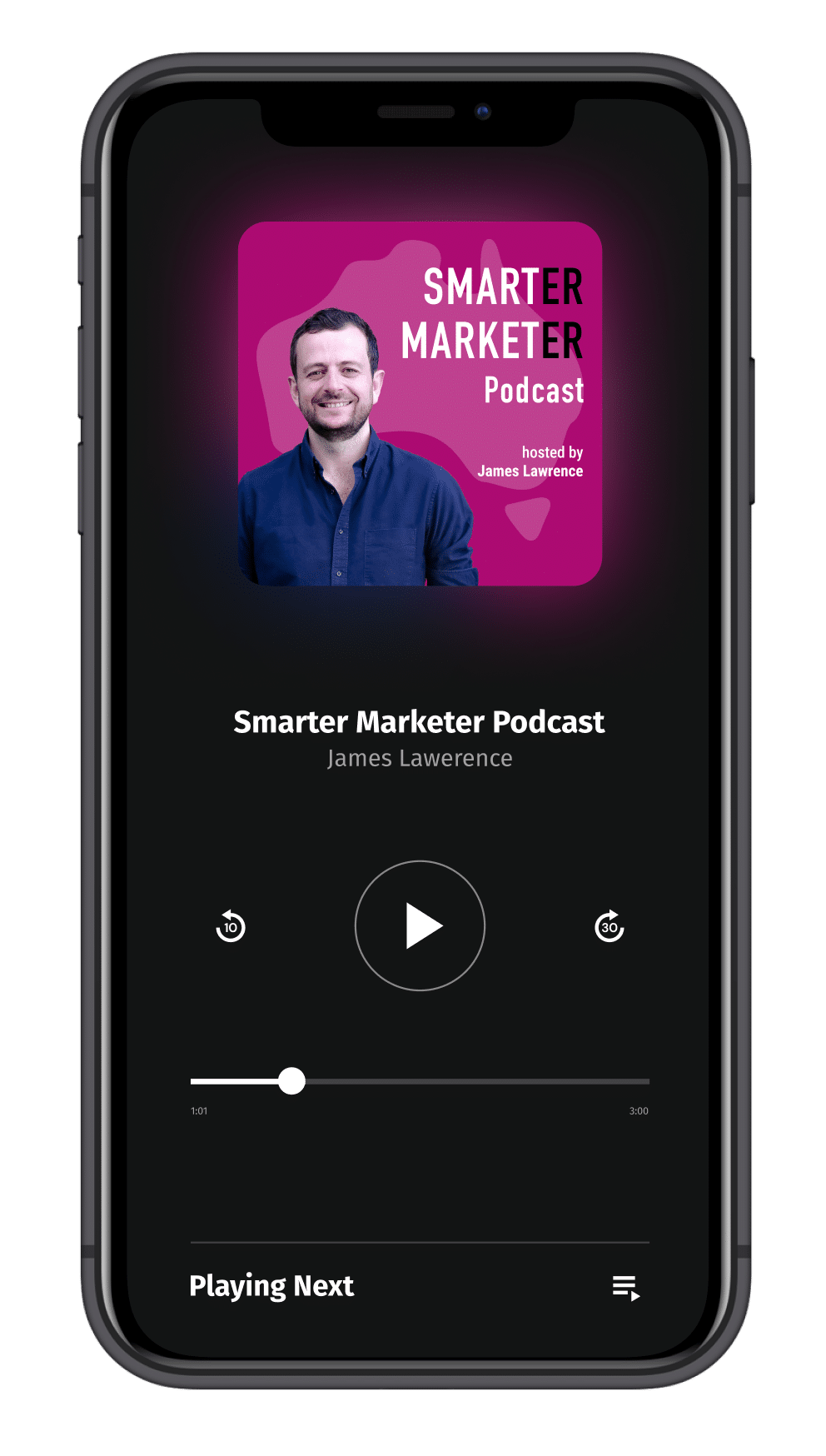
Meet James Lawrence
Host, Smarter Marketer Podcast
Co-Founder of multi-award-winning Australian digital marketing agency Rocket, keynote speaker, host of Apple #1 Marketing Podcast, Smarter Marketer, and B&T Marketer of the Year Finalist.
James’ 15-year marketing career working with more than 500 in-house marketing teams and two decades of experience building one of Australia's top independent agencies inspired the release of Smarter Marketer in 2022, the definitive podcast for Australian marketers. The show brings together leading marketers, business leaders and thinkers to share the strategies that actually move the needle.
Each episode offers candid conversations, hard-won lessons and practical insights you can apply straight away.


James has delivered keynotes at:


Lisa Macqueen
CEO, Cleancorp
About the Guest
Lisa Macqueen is the CEO of Cleancorp, a national commercial cleaning business servicing some of Australia’s most recognisable brands. With a background in sales and marketing across global hotel and resort businesses, Lisa brought a fundamentally different mindset into an industry long defined by commoditisation.
Under her leadership, Cleancorp has grown into a people-first, values-led organisation, earning B Corp certification, national recognition as one of Australia’s best places to work and a reputation for doing things differently. Lisa is also a LinkedIn Top Voice, using her personal platform to share candid insights on building meaningful brands in unexpected places.
You can follow Lisa on LinkedIn.

Transcript
James Lawrence: Welcome back to the Smarter Marketer Podcast.
I'm here today with Lisa McQueen. Lisa, welcome to the pod.
Lisa Macqueen: Thank you for having me, James. It's great to be here.
James Lawrence: Very excited to have you onto the point today. I'll do a little bio and then we can rip into the conversation. So Lisa is the CEO of Clean Corp, a trailblazing Australian commercial cleaning business.
Lisa, you began your career in sales and marketing across global hotel and resort brands, and then you stepped into the family business in a world of cleaning and turned what many see? And, these are your words, not mine. A boring category into something very dynamic. And so I think it's a really area, a really interesting area to talk about, which are businesses that might not have the pizazz and glamor of fashion or, the resorts and hotels you used to work in, but how do you market in a category where, it is a utility or a grudge purchase or something that isn't sexy.
So it'd be great to have you onto the pod to discuss that. And I thought, before jumping into [00:01:00] what you're currently doing in your day job, you're a LinkedIn Top Voice last year in 2025, which isn't a label given very easily. And I, would encourage listeners to the pod to after listening, jump onto LinkedIn and look at Lisa's kind of LinkedIn presence.
'cause it, I find it. I think people are gonna find out from your personality that, you are out there and you love talking and you've got such a great brain, but it's not. The type of content that I'd normally expect to see from the CEO of a cleaning company. So can you talk to me about LinkedIn, how you got into it and what it's done for you?
Lisa Macqueen: Yeah, absolutely. And thanks for that intro because I like the way you've explained me. I started posting on LinkedIn about three years ago, and. I've always said cleaning. It's a boring industry. People are not interested in what we do, and that pretty much goes across whether it's a prospect, a client that people are just not interested.
So I wanted to make sure that whatever I was posting was at [00:02:00] least gonna get someone interested in what I was saying. So, I went in different ways. A lot of other cleaning businesses, when they're posting, they're putting photos of a dirty floor and then a clean floor or a dirty toilet and a clean toilet, and it's just not my vibe, James.
I just didn't wanna do that. So I started writing about things that I found interesting about what I was doing as a CEO and. Developed some pillars around things that I found people were interested in hearing about from me, and it really just developed from there. And I was so shocked when LinkedIn awarded me a top voice, because I think there's only about 300 top voices worldwide on LinkedIn.
James Lawrence: It's an insane, because I think we live in this world of. Everyone gets a badge and everyone gets a tick or whatever else, but it's just not an accredit, like an award or a badge or an accreditation that people normally get. And your content gets really absurd amounts of interaction on LinkedIn, right?
Like it's, you're talking about posts that [00:03:00] have hundreds and hundreds of likes. I can, from my side looking in, I don't get to see the reach of some of them, but I could imagine that some of them go completely viral, right?
Lisa Macqueen: Yeah, they do. And it's been, no one, I don't think anyone has been more surprised by it than me because when I first started back three years ago doing this posting, I was really doing it, one, to have a voice in the industry and two, for obvious reasons.
Two, to use it as part of our marketing attraction strategy for Clean Corp. And. The fact that it started to resonate and then people started to comment and lie and share and save my posts, and then send me messages. I thought, well, okay, I must be delivering something of value to people on the LinkedIn.
Platform. And from there it's just grown. And now I'm, posting pretty much every day. Sometimes I post twice a day and I've thrown out the rule book. I just, post when I feel like posting. I talk about things that I think that the [00:04:00] community that follow me are interested in.
And yeah, it's growing. I think I'm the biggest female content creator for the cleaning industry. Certainly on LinkedIn. So something's working.
James Lawrence: Really cool because a lot of listeners to the pod are not CEOs, right? They're in-house marketers. But I talk a lot about the importance of personal brand as part of your professional development.
And I think a lot of the time marketers don't get taken as seriously in their organizations as they should. And I think. Posting on LinkedIn can be an awesome way for people in your organization to see what you are doing, what your team's doing, et cetera. What advice would you have on, I think 'cause it is hard.
I think there's a few things. I think often it's hard to get started with creating content, but I think the ideation piece is really challenging. Like what advice would you have to listeners around how you go about finding things to talk about and over time, I think. I was listening to this awesome podcast with Mr.
Beast on it. Just hearing about the [00:05:00] process that he's gone through over the years of testing and just over time finding the type of content that resonates with an audience and the type that doesn't. So what have you found that, in your experience, has helped you create ideas and tips you'd have for marketers out there?
Lisa Macqueen: Yeah, definitely, I think in the beginning it's definitely trial and error because you're starting from scratch. But the one thing that I would say is that I'm always looking for a post that stops me scrolling and, then if I see something and it stops me scrolling, I'm looking at it through the, vision or through the eyes of why did I stop scrolling?
Was it the hook? Was it the topic? What was it that made me stop? And then I dive into that. So, if it's a hook, well then maybe that's a hook that I could use in the future. Maybe it's an idea that I could add to a topic that I'm already, interested in pursuing next week. But it really.
At the beginning, it is just trial and error. [00:06:00] Once you get past that period and you start to get some traction, I think that you'll start to see what people are responding to. So for me, in our industry, people really respond to the culture piece. When I'm talking about the business as a whole and what we do internally as a team.
I find that I get a lot of engagement on that kind of post. I post a lot about my life as a CEO, things that come up, challenges people like to hear about. The things that you are going through, even if they're not a CEO, they're perhaps they're aspiring to move into that role. Or perhaps they're, at a management level, whatever it might be.
There is definitely room for, LinkedIn is quite aspirational. It's not quite as. Aspirational as Insta, but still quite aspirational in the professional world. So I think you are looking at it through that lens and looking at it through, okay, they wrote about this thing and it really connected with me.
How [00:07:00] can I make that work for my community? And I've just taken it from there.
James Lawrence: That's really cool. I think we've observed over the years that in a B2C context, organic reach is really hard to get in social media. And I think there's TikTok. A slight exception to that more recently in a B2B context almost feels the opposite, where LinkedIn and we do a lot of work with clients in a paid capacity in LinkedIn, but.
Often where I see the best results for businesses will be when you're not posting from a brand account necessarily, but you're posting, like people don't buy from businesses. They buy from people, and there's all this narrative in B2B about how do you actually bring the people to the forefront?
Which I think when we get into the conversation proper, hopefully get into, but what kind of commercial results has your organic. Founder led approach to marketing and I've had within LinkedIn.
Lisa Macqueen: Yeah. I mean, look, we've had a [00:08:00] tremendous impact from posting on LinkedIn and that goes right through the business actually, because one, it for, from a team perspective, seeing their company out on a platform like LinkedIn.
It's just, it's good for company morale. Then also when the sales team go out to see a prospect and they talk about the fact that they've seen me on LinkedIn or they talk about the posts that I put up yesterday or last week or whatever it shows that the branding is coming through. But more importantly than that is the fact that prospects see us out in the wild.
They see us out on a platform. Saying it like it is, anyone that follows me will see that it's not glossy. I don't gloss over anything. I talk about the hard stuff and the easy stuff. At the same time. I think that there is just a thirst, and it's such an appetite for authenticity from prospects.
There's so many companies out there and they're all pushing their [00:09:00] businesses, their business pages. People aren't interested in that, and that's exactly right what you said. People buy from people, and so when you're able to give your company or your brand, a face and a voice and a personality, people will buy into that.
They can connect with that. And so when the time comes for us a customer or a prospect. They need a new cleaning service. They can, they feel connected. They feel like they know us.
James Lawrence: Mm-hmm.
Lisa Macqueen: And I think that's one of the biggest factors. And the biggest success stories for us in being on LinkedIn, is that we've been able to sort of leapfrog over some of the, some of those early, if I can call them trust issues, because I've built a relationship with potential prospects.
Because I've been posting and because they've been reading what I've been posting, they feel like they know me and or they feel like they know the brand and they [00:10:00] know what we stand for as a brand. So it's had an incredible effect on the business actually.
James Lawrence: It's really cool. I wanna get into it later in the conversation.
'cause for me, for listeners. Putting aside the whole concept of marketing in a boring industry or not I think you guys do pretty much as good a job as anyone I've seen of bringing the people to the forefront in all of your marketing activities. And I think particularly in B2B, but also in B2C, it's.
It's so important and authenticity and trust and particularly as we're moving into this kind of AI world. So I think I will, I wanna get into it a little bit deeper in the conversation, but I think just to start with I suspect it's a long way from marketing, glamorous resorts and hotels and I like this conversation 'cause you were a marketer once.
You still are, but like in, in your official capacity. So can you just talk about how you got into Clean Corp? How you got into the business? Yeah, I imagine pretty different to flying around the world, staying in five star hotels.
Lisa Macqueen: Absolutely. My husband, Hamish, [00:11:00] he started Clean Corp and he ran the business entirely by himself for the first 13 years.
And during that period, he did every job description in the organization. Hamish was in charge of, and he did a great job. He grew the business to just over $700,000. Annual recurring revenue and not a bad effort, but he got to a point where the business plateaued or stalled and he couldn't grow it any further than that.
And he said to me, look, with your sales and marketing experience, I think that's the missing piece that Clean Corp doesn't have. So if you. Leave your glamorous job working for the hotel and come and work in clean Corp. I really think that this business can take off. So I laugh about it because at the time he had to do a lot of convincing James because I did not want to be moving into the cleaning space.
I was very happy in my [00:12:00] role, but I did realize that. This probably would be a good idea. And so I joined and pretty quickly, once we put the, once we implemented the marketing piece into Clean Corp, which is what that, that's my strength. Once we did that, we started to see the. Uplift really quickly. So within two, I think it was 2.4 years, we went from that 700,000 turnover to 2.4 mil in turnover and for a cleaning business, and at that time, really it was just the two of us and our cleaning operatives.
That was a real, that was a really good swing for us. And so from there, we've just built on it and built on it. But marketing has always been the heart and soul of what we do in terms of our attraction strategy. Because every cleaning business out there with very few exceptions, they all look the same if you take out their name and put in somebody else's [00:13:00] name.
Most clients wouldn't know the difference. So I was very focused from a really, right from the get go to make sure that we were as different as possible so that we could we looked, felt, and were really different to what the traditional cleaning businesses in the commercial space.
James Lawrence: Can you talk a bit, because I think you're quite modest. I think you are. Like, just talk about the scale of the business now. 'cause it's a, like we're not talking about a husband, wife claim business anymore. It's a, I don't wanna use the word because there's, we're,
Lisa Macqueen: Well beyond that we're obviously multi eight figure business.
And we have a very large team. We're coast to coast in Australia. We do regional, rural, remote as well as metro areas. And I sort of map not too long ago of all of the area of, where we'd mapped out where all of our sites were. And even I was shocked at the length and breadth of Australia and New Zealand that we provide cleaning services to.[00:14:00]
So we've really grown, we are 31 years old now.
James Lawrence: Mm-hmm.
Lisa Macqueen: And so we've. From those early days with Hamish running everything and then the early days with me coming in, we have continued to evolve and innovate. Every step of the way. And I think it really shows, and I know that our prospects feel that because we hear back, when we're going through a tender process or a quoting process we're getting that sort of feedback from them saying, you, you feel different.
You speak differently, you say different things, you look different. And I think all of those things people are searching for, they don't want. Everything to be conforming. They want things, certainly as a buyer. They want things that are going to reach out and grab them. And, you mentioned that we're a bit of a grudge purchase and That's right, that's true.
So if we can make a grudge per purchase into something that feels better, then I think we've really succeeded with [00:15:00] our marketing.
James Lawrence: It's kind of an interesting. It's 'cause marketing does exactly what you're describing. It does, right. But I think in, in, it's so obvious in so many verticals, like what role marketing plays, but I think it's, I think the more commoditized you get then the more challenge and also opportunity, right.
If you can really get it right,
absolutely.
But I think if you cleaning utilities, insurance and you look at all the, like NRMA, the help companies, like how do you own these territories that are different from the restaurant?
Lisa Macqueen: We are conscious of here.
70% of the res, 70% of the buyer's journey, if you wanna call, that happens before they even put their hand up to tell us they're interested in cleaning services. So it's up to marketing to do the heavy lifting that, that first 70%, that there, there is no buyer's journey that. Certainly in [00:16:00] my industry, we can't take them through a funnel.
The funnel these days is what the buyer wants it to be, which is, they'll go on to Reddit, they'll go on to websites, they'll go on to ai they'll ask people for for referrals. So we have to make sure everything that we do is. Hyper dialed in because at that seven, that 70% that we don't have any control over, that we can't lead them anywhere.
So we've gotta make sure that what we are, what we're putting out into the world is going to essentially lead them to our, to us and to then that. That point of them filling out a form on the website or sending us an email, putting up their hand, making a phone call to us and letting us know they're interested.
And then we'll take them the other 30% of the way. But the marketing has to do the heavy lifting for that first 70%.
James Lawrence: I'm just trying to bring up the data as we're chatting here, but I had Stuart Jaffery on the report on the pod recently, and we're talking about the B2B, APAC [00:17:00] B2B buyer journey report from 2025.
I really like it because what you're saying is, I'm a marketer. I'm a marketing agency. Like I know it, I believe it. It's true. But often there's too much gut feel in marketing and not enough kind of data behind a lot of the decision making and the research and the report. The stats are quite incredible.
Like it is. I think in that report it was. 95% of tenders, B2B procurement, all that stuff. 95% of the time the winner was on the day one shortlist, which makes sense. We buy from brands we trust, et cetera. But 75% of the time that vendor was on the list before they even went into market. And it's because they've been.
Warmed up over ho like in your contracts, I imagine a one year, three year, five years, like these are big contracts. Takes a long time. You don't just, necessarily go into market one day and decide to buy, cleaning for the Australian government, right? It's [00:18:00] a takes time for these things.
So if you're not out in market. Warming up that audience, the 9 5 5 rule. But in many instances it's the 9 9 1 rule. Right. Only a very small part of the market or in market at any one given time.
Lisa Macqueen: Absolutely. And we are never gonna see that number go down. We'll never see that number go down. It will just continue to increase.
Yeah, so it, it doesn't make any sense to me when a company is maybe having a little bit of a hard time, the first thing they do is let go of the marketing team and then the when things start to return back to, companies doing well the first. Rehires is a sales team. Marketing is what drives the, every interaction starts with marketing, in my opinion.
And I am definitely a marketer through and through. It's I might be the CEO of Clean Corp, but marketing is the number one thing that drives this business.
James Lawrence: Mm-hmm. And I think it is because it's interesting with marketing, it's, there's, then there's these two competing. Tensions. I [00:19:00] think one is that over time there's been this kind of decrease of marketers being represented at the executive level, particularly at the CEO level where like in Australia, I think of the A SX business as very few have marketing backgrounds, right?
You're often looking at finance people, et cetera, lawyers moving into the CEO or MD kind of role. But then I look at some of the most successful businesses on earth. You look at your Amazons, et cetera. And even though he might not be a marketer by trade. His vision within the business is to be the view of the customer.
It's this customer centric approach at Amazon, which is marketing, right? Like the role of marketing is to be the customer or the markets representative within a business and understanding the market. And I think, a lot of the great businesses ensure just do that so well. The Steve Jobs approach,
but it's a very interesting dichotomy between the two.
Lisa Macqueen: It definitely is. And I mean there's always the place for the lawyers and the the finance people heading up businesses. But I think when it comes [00:20:00] to being able to reach out and. Sort of metaphorically touch a prospect enough that they think of you and that you are on their list.
When they do go out to tender, that is a whole different skillset. Being able to do that in a way that not only makes sense to them, but also pushes them into action, so that is what we do as marketers. That we are in the influence game. We are in the attention seeking game, and. Whoever gets the most attention wins.
Right. So I think it's very important that no matter what the industry, and I'm a self-proclaimed, boring industry, but even an industry like. The commercial cleaning industry deserves to have a that attention. We're a $424 billion a year industry in in, in the world.
20 billion of that is in Australia. So. Although people think of our industry [00:21:00] as small and inconsequential, the reality is that we are not, we are a big industry. We just haven't played very big in the past. And I'm trying to challenge that a little bit, if I'm honest.
James Lawrence: It's really cool and I wanna get into the nuts and bolts of it.
You're a business with hundreds, probably thousands of employees, huge turnover. I bring up the Clean Court website. It's a who's who, right? Of brands that you work with or have worked with, I presume. Still working with Kudos Bank, Lynn Chocolate, Canva, the Australian government, Chobani Rebel, McDonald's, CBRE.
It's kind of Rugby Australia, McGraw, new South Wales Health. It's a who's who. Right. And for listeners I do, I think if Lisa can market cleaning in the way that you have. Anyone listening can market their product effectively as well. And if you're in a business where it is this, it's intangible, right?
It's not that different to professional services. What we do as a business at Rocket, [00:22:00] it's do you wanna show the clean floor to the dirty floor? Do we wanna show an analytics graph going up to the right law firms, accounting firms, like we're in the people business as well, and it's, how do you create that separation and I really would encourage listeners to, to look at the Clean Court website. You do such a good job of bringing people through. You do such a good job of social proof. It's like Robert Cialdini's influence has been just deployed in a really tasteful fashion.
You're laughing away on, on this website. Yes. Guilty. There you go. I had him on the pod not long ago and I was having that, I was laughing with him off camera about it. Dunno what he's done to websites around the world. But I'd be I think if you could just talk to like how you've gone about tangibly building brand credibility.
Award certifications. Just positioning yourself to show some separation from the hundreds of other cleaning companies that ostensibly are doing the same thing. Right?
Lisa Macqueen: Well, look, you say that they're ostensibly doing the same thing, but the reality [00:23:00] is actually quite different because a lot of our industry operates.
Not with modern marketing techniques or modern marketing ideas. And so what we've done and this is something that can be done in pretty much any industry, is look at what everyone else is doing and then do something. Different. And that's exactly what I did when I joined Clean Corp. I looked at everyone, and I'm gonna own up to this.
James, when I first joined, I didn't even know what I didn't know. So I looked at all those other cleaning companies and then I did exactly what they were doing. Which was, it was just even now I like hearing myself say it, but that is what I did. And I think our growth, even though we had great growth right at the beginning when I joined, we would've doubled that growth if I had not done that.
But I learned pretty quickly that looking at all of those, like making ourselves look like everybody else meant that we were then. [00:24:00] We were just another line item on a tender sheet, and it wasn't making a standout. So I moved away from that and made that conscious decision that I, what I wanted to be was, I wanted all of the cleaning industry to be over here, and then I wanted Clin Corp to be over here or as far away as possible.
And that's what we did. So. If they zigged, we zagged. It was as basic as that. And we've continued to do that. So things like posting on social media, I'm only starting to now see some cleaning companies do it. A lot of them are still doing it using their company page. Putting videos up on Instagram and showing your personality as a business.
Again, . Not many companies in the cleaning industry do that because everybody's so scared about being professional. What they don't realize is that people buy more than that. So really every step of the way. The other thing that we've done bigger than, pretty [00:25:00] much everybody else is really pushed into tech.
And we did that right from the get go when I started with Clean Corp. And way back then it was pretty basic. But now, nowadays, I mean we are building our own agent bots , we are really into ai. Here we are figuring out how we can run Clean Corp using a lot of, aI in the background to support our team so that our team can be supporting our customers much more with a face-to-face and human interaction. So things like that, I think have just helped us make our offering and who we are as a business and who we are as people, much more attractive because.
It's real. It's real people, real things, real that we're doing and delivering it in a modern way.
James Lawrence: Can you talk about the people, 'cause you just mentioned it there. I, when I visit your website, I feel like the photos of the people are actually your [00:26:00] staff members.
Yeah.
There's an awesome video of one of your team members who I think might be someone from the marketing team, literally in Martin Place, stopping office workers at lunch saying, Hey, do you know the name of your cleaner?
And then, some of 'em are like, yeah, I actually do. And we talk all the time, or others are gonna feel really bad. There's this very genuine feeling about the people which comes through. Can you talk about. What efforts you've done to make that true and what impact that has had both internally and externally?
Lisa Macqueen: Yeah, so from our perspective and certainly from the very early days, . I noticed that the cleaning industry had a bit of a bad reputation for how it interacted with its own. And so I just always wanted to have a business where I would wanna work in that business, not just be the owner of it, not just be the boss, but have a business that I'd proud to work in.
And and so early days we. Husband and [00:27:00] wife team. So it was very easy for us to do that. But as we scaled and we brought on more and more people, it became a little bit more challenging until we reflected back and said how can we make everything we do really revolve around the team?
Because if the team is happy and. If they are well looked after, they're everything to our business. We are a labor business. So it became very important to us to make, to find opportunities where we could make our team feel good about what they were doing for our clients and for clinical.
And so we started this process of. Sending out customer cards. This was sort of the first start in it. The first part of it. There's been a lot of things, but the first part was sending out cards to every new client that signed up with us. And on that card we would have a photo of our cleaning operative at, but it wouldn't be a photo of them wearing
the Clean Corp uniform, it would be them [00:28:00] in their regular life doing something that was important to them, maybe with their kids or their car or whatever it might be. And then three things about them that they were okay with us sharing. And so we started to do this and what and we designed the cards so that it looked like something that you'd stick up on a notice board and people started putting them on notice boards.
James Lawrence: Mm-hmm.
Lisa Macqueen: So our cleaning teams, whereas. In the past, nobody would say hi. If you were in the office, people's eyes would be down 'cause nobody would know you. They wouldn't really wanna interact with you. Then all of a sudden, by having this program implemented, it meant that our customers knew the names of their cleaner.
They could have a little chat, they could say hello, they could get to know each other, and it had a tremendous impact on the business. One, our retention rate went through the roof because all of a sudden the customer and the cleaner, they knew each [00:29:00] other. And the other thing was our cleaning operatives felt really valued because people were finally saying hello.
And I've worked as a cleaner many times in our business over the years and it feels a bit off when people don't acknowledge you. So we really fixed it from that perspective. And then lots of get togethers, we do a lot of acknowledgement and we talk about our. Internal and our external clients.
So internal clients are the team.
James Lawrence: It's
Lisa Macqueen: really important for us to be making sure that we are just as professional and respectful and helpful to our internal customers as we are to our external customers. And I think that's just made, an enormous amount of difference. We hired great people who actually care.
James Lawrence: I do, I would recommend if you're in a people business, no, I don't think it has to be cleaning. I think if you're in the law or in accounting or, and most of us are in people businesses, in one way or another, I would encourage you to check out the website and like I look at the about us page of your [00:30:00] website and it's got, daggy photos if you guys back in the day, right?
Like it's, that's because that's what it was back in 95 or whatever. But it feels real. And then the copywriting itself, I don't know if it's yourself or your team, but the copywriting. You can tell that it hasn't been run through ai, right? It's very genuine copy. It has a flow to it. It has a genuineness about it, and it is almost the perfect website in terms of balancing what you do, but also who's behind it and proactively deals with a lot of the OB objections that would exist in your industry.
I think it's a great , consolidation of all the kind of attributes that most people, businesses should have.
Lisa Macqueen: Yeah. Thank you for saying that. That's exactly what we were going for. So that again our personality, the personality of the brand would shine through.
Looking at the photos reading the copy in every way so that there was a congruency between what you'd see about us online. And then go to our website, what you see on our website and everywhere in between. So we've been very aligned with [00:31:00] making sure that we are consistent and that's something that certainly our industry is often accused of not being very consistent.
So it's become another thing that we use to show people that, even if it's just subconsciously to show them that this is an organization who they follow through and they do what they say they're gonna do.
James Lawrence: For for marketers listening, I think it's a really you've done a really good job of the kind of long-term marketing versus short-term marketing in B2B and then it's the whether it's the 95 5 rule or 99 1, depending what other.
Tactical things have worked for you, like other advice you'd have for marketers who are operating in a people-centric space or a quote unquote boring space, aside from great website that brings people to the fore and all the trust builders. Like what other tactical things have worked from a marketing viewpoint?
Lisa Macqueen: I think using marketing not only as. Something that [00:32:00] we do online, but also using it as something that happens behind the scenes. So making sure that we are using marketing to attract great talent into the business. And we do that via LinkedIn. For example, when I'm talking culture, people connect with that and then I get a DM saying,
i'd love to work for Clean Corp. I'd love to be considered for this role. It's worked really well for us that way tactically, it's also worked for us where we've used our CRM system to really make sure that we've got the whole journey of how someone is experiencing us. We've mapped it out and then we put ourselves through it as well.
At different times to make sure that, is this still right? Are we still doing that or have we moved on from that? I think going back and checking and retesting all the time is something that's always been very important to me. Making sure that we don't have a set and forget mindset because I think a lot of businesses [00:33:00] can do that,
they say, yes, we've got our email marketing all dialed in, but they never touch it again for five years. Nobody ever looks at it and they've no idea what it says. So we are making sure that every step of the way we're doing that. And we're also upskilling all the time. I've just started working with a new business coach, a brand new business coach today actually.
So making sure that I'm still sharpening my sort every opportunity I get and learning so that I can keep delivering great results for the business, but also great interactions for prospects and potential future hires. Moving forward,
James Lawrence: Without going into how you're performing, as a CEO, what are the core metrics that you look at as assignment that marketing's doing well or it's falling behind?
Lisa Macqueen: Oh, it's definitely. What, how many leads are we getting? That's the obvious metric. What's it costing us to get them? And then. What are we not getting? What's coming [00:34:00] through that's not coming our way and why we dial into that as much as we can. And then what are we losing?
It's one thing to win business at the at one end of the funnel, but if we are losing it at the other, what are we doing and why? Why did that happen? What was the reason behind that? I think also. Right now for us, the big one is what are we getting through ai? What's coming in there?
And is that looking bigger and better from a prospect perspective than what we've been getting say through our SEO? So we are looking at all, all of those different avenues and tweaking where we can to make sure that we're getting, the best value for our money.
And also the best opportunity for our team to make a sale from the marketing leads that we attract.
James Lawrence: Nice. And how, what impact are you seeing with AI in terms of impact on the way that your prospective customers purchase from someone like yourself? Yeah.
Lisa Macqueen: We are [00:35:00] definitely seeing an upswing.
And I think most people would say that we have had. A very concerted effort ever since, I think it was January 20, 23, we really went all in because even back then OpenAI launched chat, GPT what? November, 2022. By January, 2023, we were using chat, GPT. Actually, we were using Jasper.
Do you remember Jasper? We were using Jasper and thinking we were so clever, being able to do all these things with it. And then by February we had a paid subscription with Chat GPT, and we really have leaned into it so hard ever since. Certainly with things like our blog posting and content, making sure that we are now answering questions that are much more going to be aligned with how AI is searching for information.
So we've really pushed into that in, our FAQs our blog posts, our [00:36:00] socials as well, trying to just consolidate everything so that we are making it ma we're essentially making ourselves the best choice. For when AI is, so is serving up a suggestion?
James Lawrence: That's nice. Before we wrap up, we work with your marketing team and I end the pod with, what's the one piece of advice you'd give to an in-house marketer?
I think it'd just be good to talk for a few minutes just to look, you're a marketer who's become a CEO, who now hires marketers. What do you look for when hiring marketers? What are the traits that you think. Young marketers have or should be focusing on as they move through their career?
Lisa Macqueen: Oh, I love that question because the young marketers, what a time to be in marketing. First of all. What an incredible time. For me, what I'm looking for is someone who can look at something and turn it into. [00:37:00] An opportunity for people to come along for the ride with us. For example, being able to put to, come up with a great idea for a reel or a great, basically choreograph a reel if you wanna call it that.
And. Make sure that it's something that will align, it will hit the mark. All of that. Someone who can write, I think that is, people say, oh you've got chat GPT to do that, but you still need to know how to take the ideation out of chat. GPT. We don't just. Take stuff outta chat, JPT and go with that.
We just go over it and over it until it becomes exactly what we want. We ideate and then we create ourselves. And I think that's a really important thing for young marketers. The other thing is learn like just you have to be prepared to just jump in and learn how to use HubSpot or learn how to use whatever CRM your business is using, and then how to twist it and.
Force it to do the things that you wanted to do. And having that [00:38:00] inquiry in mind, like Lonnie, she's our digital marketing manager, and she was the one that was in Martin Place interviewing people, doing the vox pops. It was her idea to do that, by the way. Being able to say, look, this is uncomfortable for me to stand in Martin Place and interview people who don't wanna be interviewed, but hey, I'm gonna do it anyway and I'm gonna feel myself doing it.
I think being able to go outside the box and make it work is hugely attractive for employers, for young marketers.
James Lawrence: Yeah, a hundred percent. I think the curiosity piece is so important and the more the faster the world changes and technology advances. We've ridden this wave of digital marketing,
and most people in digital marketing didn't go to university and study digital marketing. They've come into it through a whole bunch of different ways and. Feels that the speed of change is only gonna get greater. So the ability to kinda learn on the job and pivot and adapt that you need that curiosity and just not gonna be spoonfed stuff that then your job's done for you and [00:39:00] feels like your team also has that kind of independence.
Where they've got that willingness to go out and think about it and bring ideas to the table and Yeah, that opportunity,
Lisa Macqueen: there is nothing I love more than a marketing meeting here because we just, we sit down by the board on the at the boardroom table and we are throwing ideas.
We're writing things up. We're constantly ideating and we start with one thing. We end with another thing. But what happens in the middle is. It's that's where the good marketing really happens because we're thinking about it in from different directions, from different angles and really looking at what topics.
Are interesting to people. What can we talk about? What can we write about, what can we be producing? And once you get the topic right, then everything else falls into place. And I think that's one of the things that a lot of people feel confronted by because how do I come up with the topic?
And I would say use, use AI to help you [00:40:00] ideate and then develop from there.
James Lawrence: Good advice. Lisa, thanks so much for coming onto the part. It's been great to chat with the CEO, who's a true believer in marketing and someone who'd been in the trenches previously and you've built an incredible business.
So congrats and thanks so much for spending the time with us.
Lisa Macqueen: Oh, so great. Thank you so much for having me on, James.
James Lawrence: Thanks Lisa.