What Is E-E-A-T in SEO? A Practical Guide to Building Trust, Authority & Expertise in 2026


What does E-E-A-T mean? Every marketer reckons they know it, but ask anyone to explain it and you’ll probably get vague answers, or a few ums and ahs.
It stands for Experience, Expertise, Authoritativeness and Trustworthiness, and it’s Google’s way of checking whether content is credible. Through a mix of human Quality Raters and machine learning, it helps the algorithm understand which information readers can believe and rely on.
Understanding E-E-A-T and its importance for modern SEO
The main focus in Google’s E-E-A-T guidelines is people-first content. This means creating high-ranking content starts with prioritising what genuinely helps readers: their questions, challenges and the value they’re looking for online.
E-E-A-T isn’t a direct ranking factor, but it guides how Google defines quality. When content shows authentic experience and a distinct perspective, it stands out. In areas like finance or health, that kind of authority decides who owns the prime real estate on search and who’s left off the map.
In 2026, E-E-A-T will define good SEO. With AI-generated material filling search results and Google’s AI Overviews changing how people consume information, trust has become the most valuable ranking signal. Technical SEO still matters, but it must align with authenticity and experience. Brands need to prove that what they publish comes from people who know what they’re talking about.
This means that when Google sees strong E-E-A-T signals, it reads your brand as credible and capable. It’s a simple equation: trusted content earns visibility. Everything else gets ignored.
What does E-E-A-T stand for?
Each letter in the E-E-A-T acronym highlights what Google pays attention to when assessing content quality:
- Experience is about whether the writer has actually lived through or dealt with the topic, not just researched it.
- Expertise looks at real skill, training or knowledge that supports their claims.
- Authoritativeness comes from being recognised by others as a trusted name in the space.
- Trustworthiness is the proof that what’s shared is accurate and honest.
Experience
Experience is about showing first-hand understanding. Google wants proof that the content creator has direct exposure to the topic.
For example, when an Australian travel brand shares a blog about driving on the Great Ocean Road, original photography and personal insights from the trip strengthen its E-E-A-T signals. At Rocket, we encourage clients to showcase lived experience through authentic examples and case studies.
Expertise
Expertise goes deeper than experience. It reflects a creator’s formal knowledge or skills in their field.
A financial services company, for instance, can strengthen its E-E-A-T by publishing articles written or reviewed by licensed advisers. In SEO terms, this helps Google understand that the content comes from a credible expert, rather than being crafted purely from secondhand information.
For brands we partner with, showing expertise might mean adding author bios or linking to professional profiles that confirm credibility.
Authoritativeness
Authoritativeness shows that other people trust your voice. It is earned when audiences, media and peers recognise your brand as a go-to source.
A national retailer builds authority by showing up and staying active on its own channels. This helps earn mentions in trusted Australian publications and keeps those positive reviews rolling in. Over time, the combination of credible sources and strong backlinks from respected industry sites reinforces that reputation and keeps the brand top of mind.
As an SEO agency, Rocket helps businesses grow authority by combining content creation with strategic link building and technical SEO services to prove relevance and reliability online.
Trustworthiness
Trust is the foundation that holds everything together. Without it, experience and expertise lose their weight.
Trustworthiness means being transparent, factually correct and user-first. A healthcare provider, for example, can build trust by clearly listing sources and keeping contact information visible.
For our clients, trust also comes from a tone that is honest, helpful and easy to understand. At Rocket, we see trust as the bridge between human connection and search performance, strengthened through every campaign led by our content marketing agency.
E-E-A-T vs E-A-T: What changed and why it matters
For a long time, Google judged content through three lenses: Expertise, Authoritativeness and Trustworthiness. Then, in 2022, it added one more.
Experience.
That single addition changed how credibility is measured online.
Experience asks a simple question: Has the person behind the content actually lived what they are talking about?
This means that research is no longer enough. Writing should now come from involvement, and not simple theory. This way, the audience forms a real connection with the information they find online.
This shift matters most where accuracy truly counts: health, finance, legal or safety topics. These are areas where poor information can cause harm. Google wants to make sure the content people find comes from those with first-hand involvement in the subject matter.
For marketers, this means working with subject matter experts who have seen or built their narrative. Well-researched generalists can still produce satisfactory work, but experience gives content the weight and trust that both readers and algorithms look for. In 2026, that distinction is what separates a credible brand from everyone else fighting for clicks.
Does E-E-A-T impact rankings directly or indirectly?
Marketers often ask if E-E-A-T is a ranking factor. Technically, it is not. You will not find it in any list of direct signals. But the truth is, it shapes almost everything that performs well in search.
Google’s Quality Raters use E-E-A-T SEO as a guide when reviewing content. Their job is to decide if what they are seeing feels trustworthy and helpful. Those assessments feed back into how Google updates its systems. Eventually, the algorithm starts rewarding the same kind of content that reviewers rated highly.
So, while there is no E-E-A-T score hiding behind the scenes, the impact is clear. Pages that demonstrate experience, expertise and credibility tend to excel in rankings. They feel credible to readers, which means they also feel credible to Google.
In a nutshell, building E-E-A-T is geared towards credible, clear and helpful content for the readers.
E-E-A-T in the age of AI content
Why Human Review is Critical
AI can make content production faster, but it cannot make it smarter. Human involvement is what turns information into something credible, on-brand and worth reading.
Accuracy
Human editors keep content grounded in truth. They check facts and fix small mistakes that automation overlooks. When your details are airtight, your audience feels they can rely on you and stay on board without hesitation.
Experience
Real experience gives content weight. Writers and subject matter experts bring stories and insights that only come from the fieldwork. That’s what makes content feel genuine and useful.
Brand voice
Your brand voice is shaped by people who understand your audience. Reviewers refine tone and emotion so that every line sounds human and on-brand.
Compliance
For finance, health or legal content, professional oversight is essential. Experts ensure information is safe to publish. That level of care protects both your readers and your brand.
Human review keeps your content honest and connected. It’s how brands maintain trust as automation gradually becomes the norm.
How E-E-A-T affects your SEO performance in 2026
Search is changing fast, and so is the way visibility works. With Google’s AI Overviews and the rising popularity of zero-click searches, information is being delivered directly on the results page. This leads to fewer clicks and less control over how your content is discovered.
Instead of ranking alone, brands now compete to be referenced or summarised by Google’s systems. The common thread among those that appear first? Content grounded in strong E-E-A-T principles. Google’s AI relies on content it can trust. Pages that demonstrate clear expertise, experience and authority are more likely to be surfaced or cited in AI-generated summaries.
This shift marks a new era for SEO. Success is no longer measured only by traffic. It is also based on credibility, or how confidently Google can rely on your content when shaping its own responses.
For marketers, this means future-proofing SEO by embedding trust and authenticity in everything you publish, rather than relying solely on optimisation. The brands that focus on credibility-first SEO today will be the ones that still hold visibility tomorrow.
The role of E-E-A-T in YMYL and non-YMYL content
E-E-A-T SEO impacts all types of content, but how it applies depends on what you publish. Some topics need expert review and precise facts. Others need proof that a real person has experienced and fully understands what they are writing about. Either way, Google is constantly on the search for proof of trust.
YMYL
YMYL means “Your Money or Your Life.” It covers topics that can shape decisions about health, safety, finances or legal matters. A blog about nutrition or investing fits into this group because people act on that information.
Google treats this content carefully. It expects evidence that can be verified. It also scrutinises whether the author has the right background to speak with authority. If the topic can affect someone’s well-being, that proof of expertise matters.
In YMYL spaces, E-E-A-T decides what earns attention. It’s what separates brands that build lasting credibility from those that lose it.
Non-YMYL
Non-YMYL content includes reviews, travel advice, tutorials and opinion pieces. The standards are still present, but applied differently.
Here, Google focuses on experience. It is less about formal qualifications and more about proving you have used, visited or tested what you are writing about. A guide written after visiting a place or using a product carries more weight than something summarised from research alone.
Even outside regulated industries, true insight still wins. The content that feels human, that sounds like it came from someone who has actually been there, is what performs best.
Content best practices to demonstrate E-E-A-T on your website
Showcasing first-hand experience through stories and media
Experience is shown, not claimed solely through narratives. The best proof and usage of E-E-A-T principles lives in your own results. Client stories, case studies and testimonials give weight to your expertise and turn abstract claims into tangible success.
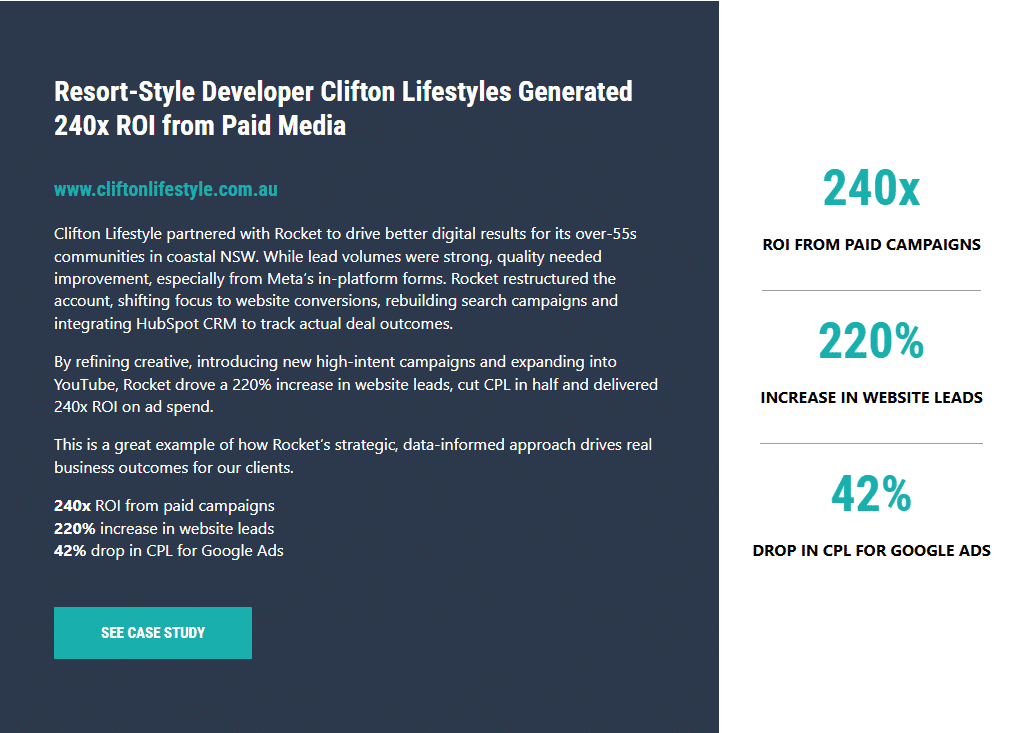
Clifton Lifestyle’s strategy with tested creative and verified data
When Clifton Lifestyle partnered with Rocket, they were already generating solid lead volumes across Meta and Google Ads, but wanted to focus on quality. Through a full-funnel performance strategy, Rocket shifted its approach from volume to value. By moving to website conversions, refining creative and integrating CRM data, Clifton gained visibility from click to closed deal. The result was a 240x return on investment and a 42 per cent drop in cost per lead.
Rocket demonstrated its expertise and experience by using real performance data to shape the creative and media driving Clifton’s results. Our team developed and tested multiple creative variations, refining copy length, messaging angles, static assets and animations to identify what resonated across Clifton’s different community locations. Clifton also supplied their own live-action videos, which complemented the creative produced by Rocket and added authenticity to the broader campaign story. With HubSpot providing verified closed-deal data, we could show exactly how prospects engaged, enquired and converted across the funnel. This turned Clifton’s performance into a clear, evidence-driven success narrative grounded in tested creative and trusted data.
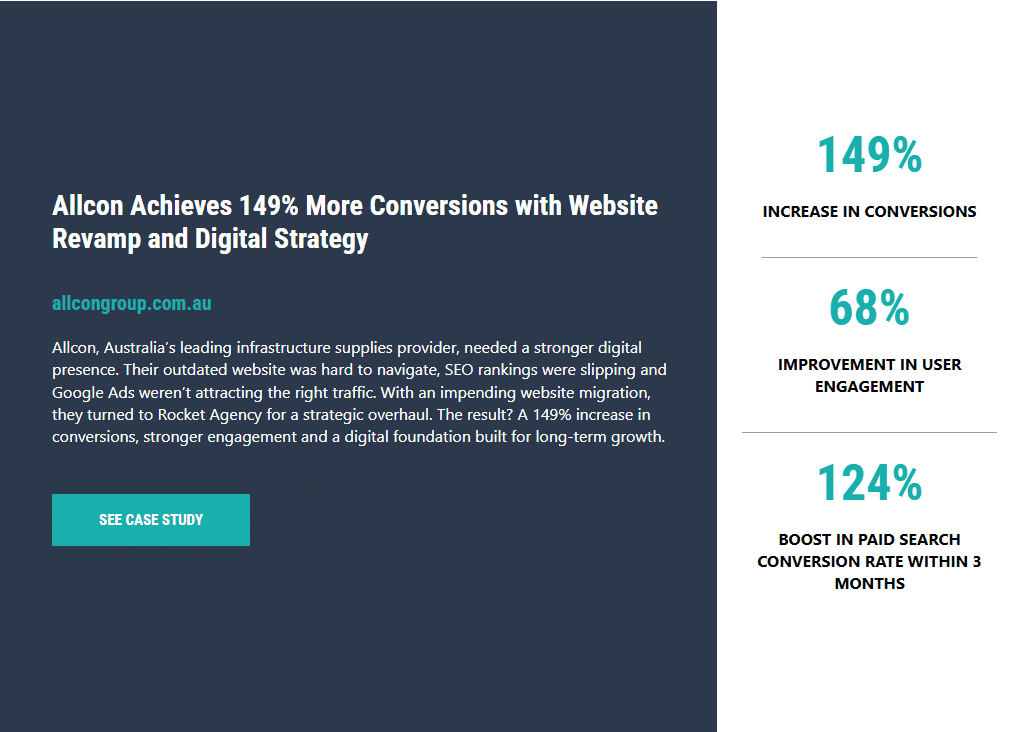
How technical depth and credibility resulted in Allcon’s conversion lift
It was a similar story for Allcon, a national infrastructure supplier ready to modernise its digital presence. Rocket rebuilt their website from the ground up, preserved SEO strength through a seamless migration and rebuilt their paid search strategy for higher intent and efficiency. Within three months, conversions rose 149 per cent, user engagement lifted 68 per cent and paid search performance more than doubled.
Rocket’s role in Allcon’s transformation highlighted real technical experience in action. Instead of adjusting around the edges, the team rebuilt the digital environment end to end: a full website redesign, a smooth SEO-safe migration, faster load speeds, stronger security and tracking that finally produced reliable insight. For many lean content projects, migrating straight to a lightweight static website framework is the most direct way to hit those speed and security benchmarks. On the performance side, Rocket restructured Google Ads, fixed targeting gaps and aligned campaigns with the products that mattered most to Allcon’s customers. These improvements were backed by verifiable data and tangible gains in conversions, engagement and search visibility, giving Allcon a digital presence that demonstrated authority and trust through results.
Highlighting author expertise and credentials
Authority starts with who is behind the content. Readers and search engines both aim to confirm that your advice comes from someone qualified to give it. Because of this, every article should include a byline and a short bio that explains the author’s experience and credibility in plain terms.
Where possible, link author names to their professional profiles, such as LinkedIn, or to affiliations that confirm their expertise. For topics that fall under YMYL categories, it’s also worth including expert review or sign-off from accredited professionals. This adds another layer of trust and demonstrates accountability.
When readers see a name they can verify, backed by experience they can trust, they engage more deeply. It shows that your content is led by real people with expertise, exactly what Google wants to surface and what audiences remember.
Earning authority via mentions, backlinks and PR
Authority can be likewise built when other credible voices recognise yours. Google pays close attention to how often and where your brand is referenced. Backlinks from trusted sites, mentions in reputable media and thought leadership contributions all help confirm your expertise.
High-quality backlinks are still one of the strongest indicators of authority. They act as digital referrals, informing Google that your brand produces content others rely on. But it’s not about quantity. One link from a respected publication can outweigh dozens from low-value directories.
Digital PR and mentions like these show what E-E-A-T looks like in motion. It’s not just about publishing good content, but also being recognised for it. When credible sources cite your brand, invite your leaders to speak or share your insights, it sends one clear message: you are trusted and relevant.
Building trust through transparency, UX and site security
Trust lives in the quiet parts of a website, such as its design and the way information is presented. When a site feels trustworthy, people stay longer. Google sees that.
Accessible contact details
Transparency starts with clarity and the observance of content best practices. Each page should show who you are and how people can reach you. Clear author attribution and accessible contact details all reassure visitors that your brand is genuine.
HTTPS and privacy policies
Security and user experience matter just as much. A secure site running on HTTPS, with a mobile-friendly design and no intrusive pop-ups, creates an environment people feel comfortable engaging with. Policies like privacy statements and disclaimers also show that your business values transparency and user safety. To further strengthen security, a DAST tool helps identify vulnerabilities in real time, ensuring your website remains safe and trustworthy for users.
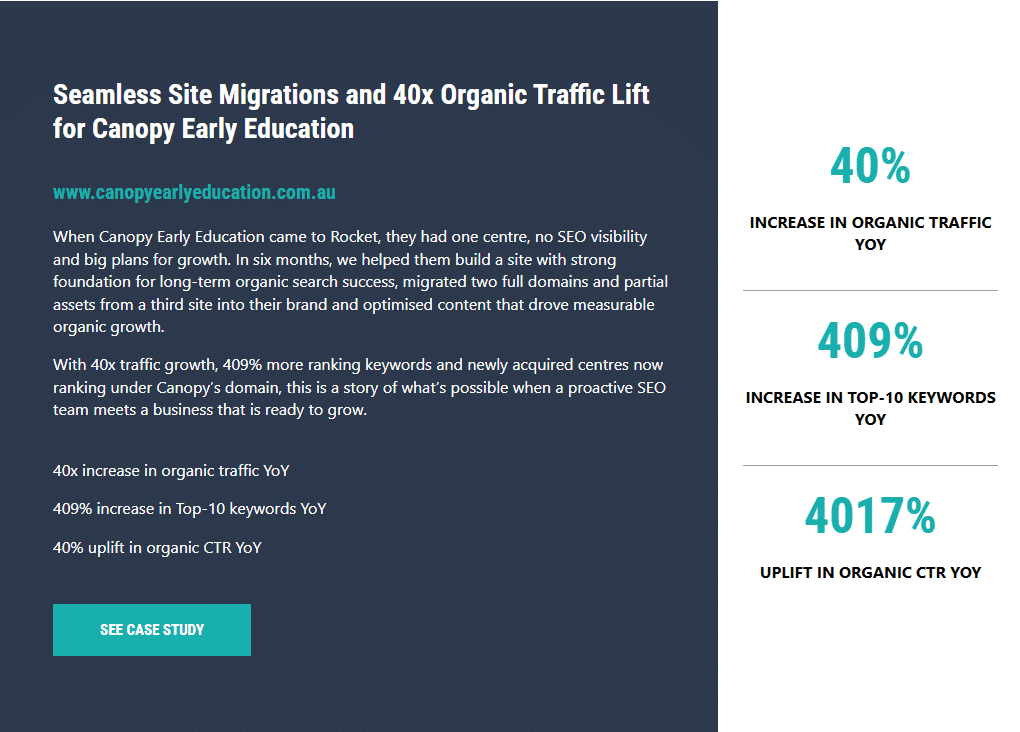
How a secure website helped Canopy Early Education build trust and organic growth
The results at Canopy Early Education demonstrate this clearly. When they came to Rocket, they were a single-location centre with no SEO foundation and limited visibility. Our team built a scalable, user-focused website and managed multiple SEO migrations without losing a strand of equity. The new site was fast and secure, with upgraded hosting, improved HTTPS implementation, tightened permissions and a clean, stable backend that protected parent data while supporting future growth. Within six months, organic traffic increased by 40 per cent, top-10 keyword visibility grew 409 per cent and organic click-through rates improved by 40 per cent.
By showcasing consistent branding and local content across each location page, Canopy’s site now reflects the same trust and care parents experience in person. It is a simple equation: transparency, security and good user experience build confidence. When users feel that confidence, Google does too.
Final thoughts: E-E-A-T is a long-term strategy, not a quick fix
E-E-A-T is built over time through consistent effort, real expertise and a commitment to giving people something valuable. The brands that lead in search are the ones that prove credibility day after day, not those chasing shortcuts or quick wins.
Search is moving fast. AI-generated results, zero-click searches and changing algorithms will keep reshaping how people find information. But the principles behind E-E-A-T stay the same. Be transparent. Publish content that reflects true knowledge. Build authority through results and relationships. And above all, keep your audience’s trust at the centre of everything you create.
At Rocket, we help brands do exactly that. From content strategy and SEO to performance marketing, we build systems that grow trust and deliver measurable results. If you’re ready to turn your digital presence into a long-term engine for credibility and growth, let’s talk.
About the Author

Joe is an award-winning SEO leader with a proven track record of scaling high-performing teams and delivering measurable results. Joe has driven organic growth for global brands like Amazon, Coca-Cola, ANZ, and Dulux through innovative strategies and data-driven insights. With over 20 industry award nominations - including Best SEO Agency APAC 2024 and Best SEO Campaign - Joe is recognised as a leader in the field. Passionate about building impactful teams and exploring the transformative role of AI in SEO, Joe brings a forward-thinking approach to digital marketing at Rocket Agency.
Stay Ahead in Digital Marketing
Join 20K+ Marketers Who Get the Inside Scoop
Other Articles you might be interested in…