Defend your SEO and protect your rankings in the face of a website migration
You’ve made the big decision to migrate your website. Congratulations! Maybe all you’re changing is the design of the site. Maybe it’s bigger than that and includes a new CMS, a domain name change, the entire structure of the site. Whatever the scope, we bet you’ve not made the decision lightly and are going ahead to improve the user experience on your site and hopefully reap the benefits of more traffic and conversions. So far, so logical.
But what if the opposite happens? All the work you’ve done positioning your great content is undermined by the speed of your new site, some technical limitations or decisions you’ve made around the site structure, and then you can only look on in horror as your rankings fall. It’s not inconceivable. In fact, it’s likely, unless the migration is managed appropriately from a site migration SEO point of view.












Our SEO Migration Process
As an SEO migration agency, Rocket has put together an exhaustive process of audits and recommendations to ensure that your new site is something to celebrate, not regret. Our deliverables are thorough and comprise every step of the migration process.
Content Risk Audits
Your existing rankings are a function of many factors relating to the pages on your site; their content, structure, metadata, position in the overall hierarchy and internal linking strategy. Often, when you build a new site, pages are left behind, either deliberately or accidentally, or restructured in ways that are not beneficial for SEO. Our content risk audits ensure that your most important content carries over to your new site optimally.
Technical Audits
A new site is an opportunity to fix all those technical issues that have dogged your old site for some time. Rocket’s thorough technical SEO audit processes, as part of our website migration service, ensure that your new site meets all our best practice recommendations. From site crawling to folder structure, internal links to error handling, we’ll provide a detailed list of issues to your developers based on staging a site analysis and iterate until resolved.
Redirect Mappings
The reason to undergo a migration project is to protect the SEO value of your site. Once your old URLs disappear, you need a way to tell search engines where everything’s moved. Mapping redirects ensures that users and search engines are directed to the right pages, preserving traffic and rankings. By identifying the most relevant new URL for each original URL and providing this list, we eliminate dead ends for users and search engines, maximising the chance that a new page will continue to rank for valuable keywords.
IA and Taxonomy Reviews
A website rebuild usually brings more structure. A rebuild is a chance to help search engines better understand the content on your site by ensuring it reflects the hierarchy of your topics. A dig through IA (Information Architecture) and taxonomy review can reveal areas where your site's organisation can be improved. Maybe your navigation needs an overhaul or your pages need a new order. Tuning up these areas helps your SEO results.
Developer Support
There’s nothing worse than nearing the end of your rebuild only to realise that the front-end technology used limits how search engines can access your content – trust us, we’ve seen it happen. To prevent issues such as this, we’ve written our own proprietary handbook to help developers code with SEO in mind. This will be provided to you at the start of your rebuild project. As part of your SEO migration strategy, we’ll continue to work with your dev team as needed to advise on template design, secondary navigation and anything else that will support your SEO.
Benchmarking & Monitoring
Despite your best efforts, it’s not impossible for site rankings to dip after a migration, and performance has to be monitored closely to ensure this is a short-term effect and not the start of a long decline. As part of our SEO migration services, we’ll benchmark indexed content, keyword and page performance, site speed and more, and review it regularly post migration. Our process means we identify any causes for concern early and take any remedial action that’s required.
Industry-recognised digital agency
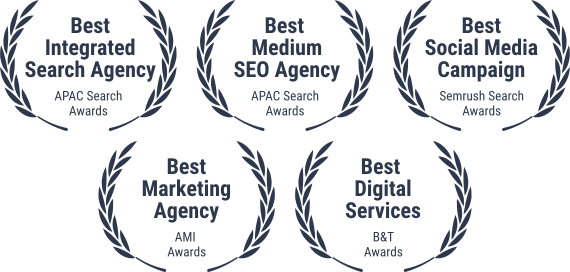
Rocket is a Google Premier Partner, a title held by only 3% of agencies in Australia. We were the first Bing Select Partner in the country and continue to lead as a Facebook Business Partner and HubSpot Platinum Partner for our work in marketing automation. We’re also a TikTok Agency Advantage Partner, recognised for driving results on one of the fastest-growing platforms in the world. On top of that, we’ve been named Australia’s Top Full-Service Digital Company on Clutch and one of the AFR Boss Best Places to Work in 2023.






Why choose Rocket to support your site migration and protect your rankings?
We’re an SEO migration agency of 50+ digital specialists with a proven record of managing site migrations to minimise any disruption.
Detailed analysis and project plan
No two site rebrands and migrations are the same. Our detailed questionnaire ensures we’re aligned on the scope and objectives of your website migration and allows us to propose a series of SEO strategy deliverables best able to protect your site from loss of traffic. A clear plan also helps avoid issues like broken internal links, duplicate content, loss of backlinks value, keyword ranking drops and missing metadata, while ensuring redirects are implemented correctly and your site structure supports long-term SEO performance.
Comprehensive process
With years of experience and an eye on the latest SEO trends, we’ve compiled a detailed list of all the critical checks that need to be carried out before migrating. As we audit your site, we’ll engage with your developers to ensure work is done to our standards — including verifying 301 redirects, checking for broken links, auditing metadata and page structure, reviewing XML sitemaps, ensuring proper canonical tags and testing site speed and mobile performance.
History of migration success
Clients who come to Rocket for our SEO migration services can relax knowing they’re in safe hands. We’ve successfully moved more than 50 sites over the years, and we focus on clear communication and careful planning to protect rankings along the way. Our team knows what to watch for and how to handle the details, so your SEO migration runs smoothly, and most importantly, your SEO performance stays on track.
Post-migration support
We don’t stop once your new site goes live. From technical audits on the live site, checking that metadata has been carried across correctly, closely monitoring indexed pages and rankings, submitting updated sitemaps and being on the alert for any issues, we continuously adapt to new information with sensible recommendations. We can also hold regular meetings with you to review performance and provide recurring reports, keeping you informed on rankings and optimisation opportunities every step of the way.
Experience across various CMSs
Rocket has experience working across a wide range of content management systems, including WordPress, Shopify and larger proprietary platforms. We’ve managed different types of website migrations — from restructuring site architecture and user flows to overseeing major design and code revamps, porting sites between CMSs and handling domain or subdomain changes. Our team understands the technical and content considerations required to mitigate risk and maintain performance throughout the process.
Meet our SEO Team
With technical expertise and content strategies that climb rankings and attract high-quality traffic, our Rocket power ensures you get found first.

Head of SEO & GEO

SEO Content Manager

Senior SEO Specialist

Senior SEO Specialist

SEO Specialist

SEO Specialist

SEO Coordinator

SEO Coordinator
Stay Ahead in Digital Marketing
Join 20K+ Marketers Who Get the Inside Scoop
Types of site migration and SEO services, whatever the nature of your migration.
Site redesigns
Domain changes
New CMS

Redesigning templates may lead to changes in site navigation and internal linking structures, which can affect how search engines discover and prioritise content on your website. You’ll probably need to review and update your website content as well.
Working with an SEO migration agency means you can optimise that content around the right keywords and set yourself up for stronger SEO across the board.
Rocket will ensure that internal links are properly updated and site navigation is aligned for the best user experience.

Switching domains? Every URL changes, so you need solid redirects from the old site to the new one to keep your SEO value intact.
A thorough domain migration SEO project ensures search engines are notified about the change through correct configuration, updated sitemaps and submission of new URLs so pages can be re-indexed efficiently.
A domain change can temporarily affect your website’s reputation as search engines reassess the new domain. We make sure the right signals are sent to maintain and rebuild your site’s trustworthiness and authority.

Every CMS is different. When switching to a new CMS, technical implementations such as structured data markup, XML sitemaps, canonical tags and mobile responsiveness need to be properly configured.
A new CMS may also affect user experience and site speed, as well as introduce limitations around URL structure, thereby requiring a whole set of new URLs.
A site migration SEO project ensures these technical elements are implemented correctly to maintain or enhance SEO performance and that any new URLs are mapped and redirected appropriately.
Partner With The Best SEO Migration Agency in Australia
Let’s talk
Speak to one of our Senior Consultants to clarify your website migration service objectives.
Kick-off SEO migration project
Our team of SEO specialists will propose a timeline of work based on how long it takes to migrate a website and perform a series of deliverables, both pre-launch and post-launch.
Breathe a sigh of relief
Any downturn in rankings is likely to be small and short-lived, as your careful preparation and SEO migration strategy have set you up for ongoing success.










Free Live Session
AI Search in Australia: How to Rank in ChatGPT & Google AI
Wednesday, 6 May 2026 | 11 AM AEST
Register Now
James Lawrence
Co Founder

Joe Alder
Head of SEO
Rocket has been featured in:











TESTIMONIALS
Kind Words From Our Clients
Our clients say it best about our digital marketing agency services
"Rocket is simply awesome to work with and show their expertise at every turn. Our results were just brilliant: 720% growth month-on-month. They made my life easier and continue still to deliver results. What more could I want? Thanks Rocket!...

"One of the greatest digital agencies in Sydney! Love working with the team! Rocket Agency has transformed our digital marketing efforts. Their proactive approach and dedication to understanding our business have been outstanding. They don’t just work for us; they...

"They have a solid team who takes the time to align their efforts with company objectives, rather than wasting time on projects and discussions that don’t matter to the bottom line. Revenue in one search-optimised category has increased by 122%...
"Rocket and the Upguard team have been great partners the last couple of years, they have understood our priorities with PPC of showing revenue impact and how we don't care about "vanity metrics". They are an extension of our marketing...

"In agency land, the client is often pitched a dream that isn't delivered. It's been a pleasure to find the exception to the rule."

"My experience with digital agencies has not always been great, however I find that [Rocket] are transparent, accommodating, professional and have made a difference in lead generation for Pooled Energy."

"Rocket have been integral to growing our business from a B2C perspective. Their commitment to quality and efficiency is obvious, and they are a true partner to our team."
"Rocket has always been instrumental, methodical and flexible in their approach to our digital marketing needs. They are fantastic to work with. We saw an increased sales revenue of 18% (YoY), even in the midst of very challenging times."

"We've experienced a real win-win through a strong, mutually respectful and truly collaborative partnership [with Rocket]. Nothing is more important than having a trusted partner, giving us 100% confidence they'll deliver the very best for our clients too."
"I've been working with Rocket on our paid digital advertising since early 2020 and have been so happy with the results. We have a great in-house team, but there's no way we could keep up with the changing Google landscape...

"Rocket have been fundamental in the development of our digital marketing. They have been with us from our inception and have helped our company grow and transition to an ASX listed company which currently has 35 supermarket centres nationally anchored...

"As a marketing team, we're quite hands-on and like to get involved as much as possible. Partnering with Rocket was an obvious choice, as they welcome the involvement rather than seeing us as a burden. Anyone working in the entertainment...

"I cannot speak highly enough about Rocket Agency and the exceptional services they provided to the University of Notre Dame. They made us a priority, and their willingness to understand our unique needs and tailor their strategies accordingly was exceptional."

"Since day 1, the team has been consistently responsive and professional. Their communication is spot on, and they always have a can-do attitude to overcome any challenges that arise. Rocket’s technical capability and strategic expertise played a key role in...

"Outstanding quality of work, strong client focus, a genuine commitment to achieve exceptional results."

"Great account management, creative strategy and amazing team :)"

"Great customer service and great attention to detail. A lovely team to work with!"
Visit Our Offices
Our Sydney office is located in the creative heart of Surry Hills, just a 3-minute walk from Central Station. You'll find Rocket's second home in QV Melbourne, right near the State Library. If you're nearby, we'd love to catch up over a coffee.





SEO Blogs

Blog Writing for SEO
Boost your website's visibility and increase your organic traffic with blogs.
Read ArticleHow to Rank in ChatGPT: Your Questions Answered
ChatGPT is reshaping how Australians search and buy. Discover practical strategies to make your brand…
Read Article
ChatGPT Traffic Converts 5.1x More Than Organic Traffic
ChatGPT traffic converts 5.1x more than organic traffic. Discover why and what it means for…
Read ArticleHow to Structure Content for AI SEO
Learn the exact content structure that gets your pages ranking in both search engines and…
Read ArticleHow to Track & Monitor AI Search in 2025
Learn why tracking ChatGPT and AI search is challenging, which tracking options exist and how…
Read Article
How Much Do SEO Services Cost?
Here’s a guide to the average prices you can expect for SEO services in Sydney.
Read ArticleHow to Improve SEO Rankings
How to improve Google organic ranking: drive traffic to your website with a solid SEO…
Read ArticleHow to Outsource SEO: A Comprehensive Guide
A comprehensive guide on how to choose the right SEO agency for your business.
Read ArticleHow to Choose an SEO Company
Questions to ask your SEO agency and whether SEO services actually work.
Read ArticleYour Complete Guide to Local SEO Citations
Discover the importance of citations for local SEO and how to acquire them.
Read ArticleHow to Rank Better on Google Maps with GMB
Follow these easy steps to improve your GMB profile and skyrocket your Google Maps ranking.
Read ArticleBenefits of Local SEO
Local SEO can help you get noticed in your area and attract customers to your…
Read Article
5 Key SEO Trends in 2022
Here are the key SEO trends we’re seeing in 2022 when it comes to best…
Read Article
6 B2B Digital Marketing Metrics Service Businesses Should Measure
Here is a list of marketing KPIs that we believe you should use to measure…
Read ArticleWhy SEO Migration Is Critical To Your Website Redesign
Chances are your business would benefit from a website redesign. Here’s how you can freshen…
Read ArticleWe’d love to help protect your SEO rankings as part of a site migration project.
Drop us a line.
If you’ve got a challenge we’d love the chance to come up with a solution. Most of all though, we’d love to help grow your business.
SEO Migration FAQs
A site migration refers to the process of making significant changes to a website that can impact its URL structure, design, content, hosting or platform. This could involve moving a website from one domain to another, changing CMS platforms, restructuring URLs or redesigning your entire site.
Rebuilding your website is a big deal and usually undertaken in an attempt to improve it from a user experience perspective, but really, it’s a great opportunity to improve it for search engines as well. Properly organising your content, improving navigation, reviewing content to ensure it’s relevant and valuable and implementing technical enhancements are all things that should help your SEO. Conversely, though, a migration that is ignored or managed incorrectly from an SEO perspective could well have a negative effect on your site visibility and organic traffic.
If not handled correctly, migrating your website can lead to temporary or even long-term negative effects. Changing URLs can make you lose visibility for pages that used to rank. Content that is modified or not properly migrated can result in a loss of keyword relevance and overall SEO value. And technical issues, such as broken links, duplicate content and website speed, can negatively impact search engine rankings and user experience.
But there are also opportunities. Moving a site to a new host is a great time to take stock of your pages and ask yourself how they can be improved both for users and search engines. An improved information architecture, better-organised content and the use of SEO modules as part of an internal linking strategy – all of these should improve your SEO performance in the long run.
The most important thing when you transfer a website to a new domain is to minimise the negative impact on search engine rankings and organic traffic. You can do that by having a comprehensive site migration SEO plan in place.
When you want to transfer your website to another host, how long it takes depends on how much involvement you would like from your SEO migration agency. A comprehensive migration aimed at getting the very best results from your new website would start at the very beginning of your rebuild project, consulting on strategy and supporting your developers along the timeline of the build. Equally, in many cases, we will get involved in the final month before the go-live date and ensure that the migration goes smoothly.
What is most important is that when you are going to transfer hosting of a website, you factor in the time for an SEO agency to audit your staging site once your developers have finished their work and all content has been built out. There should always be a period set aside for testing, and this is the best time to ensure that the site is in good technical health, content risks are minimised and redirects are in place.
Ultimately, how long it takes to migrate a website depends on delays at your end. Having been involved in hundreds of such projects, we can confidently say that web rebuilds rarely go according to plan.
This is definitely possible. Even the smallest website changes can have unpredictable effects on rankings, and the bigger the rebuild, the greater the unpredictability. In addition, rebuilds often involve a large number of new URLs. Even in cases where content is unchanged, search engines need to index those URLs, which takes time.
We can mitigate this issue by following a clear process, which includes conducting thorough SEO audits, mapping URLs, implementing proper redirects, optimising content, monitoring technical aspects of your website and continuously tracking performance post-migration.
A realistic expectation of the effect of a site migration that is managed well would be a temporary drop of 5-10% of organic traffic while search engines crawl new content and then a return to pre-migration figures (or higher if the migration has introduced improvements).
Redirects and URL mapping are make-or-break. Simply mapping deprecated pages to a catch-all page like the home page is insufficient. If a page ranks well for certain keywords, the mapped page needs every opportunity to rank for those same keywords and so needs to be relevant. This is a simple process for small sites, but a large and time-consuming process for complex sites with thousands of pages.
We start by crawling your entire site and making sure every page has a home on the new site or redirects cleanly to the most relevant page. We’ll build a complete map: old URLs, their new locations and the proper redirects. Then we hand that to your developers to implement. No dead ends, no missing pages.
The cost of rebuilding or migrating a website depends on several factors, with the size and number of pages being a major driver. A small site with a few dozen pages is simpler than a large site with hundreds of pages. Other considerations include site complexity, platform changes, redesign requirements and the level of SEO, content and technical support needed to convert an old website to a new website. Professional guidance ensures a smooth migration, protecting rankings, avoiding downtime and maintaining traffic during the transition.
Recovery time can vary depending on the size of your site and the complexity of the migration, sitemaps, how well its redirects are and how metadata is handled. Rocket carefully plans and executes migrations to minimise ranking disruptions and continuously monitor performance post-launch, helping your site regain its visibility as efficiently as possible.
There’s no universal answer for hosting. The best hosting depends on your site’s size and technical requirements. Whether you’re importing a website to WordPress or need to move a WordPress site from one host to another, Rocket can assess your current setup, recommend reliable, high-performing hosting solutions and ensure a smooth migration that protects SEO.
Yes. Rocket has extensive experience with domain migration and SEO rebranding projects. We’ll plan the domain migration SEO, implement proper redirects, update metadata, notify search engines and monitor post-launch performance to protect rankings and your brand authority throughout the transition.
A CMS migration can impact SEO if not managed carefully. Rocket ensures all redirects, metadata, structured data and URLs are preserved or optimised. We'll also audit the new platform for technical SEO issues and monitor rankings after launch to minimise any negative impact on your search visibility. Don't rely solely on luck. Contact us today about our SEO migration services.
hello world!